
Maplewood houses have character, and a lot of that character comes from age: plaster walls, wood floors, deep porches and basements that were dug long before anyone thought of finishing them. Age also means pipes, drains and foundations that have been working for a very long time. When something finally gives, Maplewood water damage restoration from DryMax handles it start to finish. Our IICRC certified crew removes the water, dries the structure, takes care of mold if it appears and rebuilds what was lost. We answer (973) 992-4400 every hour of every day.
An old commuter suburb with old house problems
The railroad reached this area in 1838, and in 1868 local farms were subdivided into lots for houses, turning the place into a commuter suburb. Around 1900, builder Edward Balch began developing homes here, eventually 176 of them. The 1920s brought another big wave of new residents and new buildings. A large part of the housing stock in town traces back to those early decades.
Houses that old have usually been updated in pieces. A kitchen redone in one decade, a bathroom in another, the basement partly finished later still. Each round of work leaves a mix of old and new plumbing. Where a newer PEX or copper line ties into an original galvanized or cast iron run, that joint is often where trouble starts.
Cast iron drain stacks are a common one. They can crack along the seam after many decades, and the leak is often slow and hidden inside a wall or behind a basement ceiling. You might notice a stain, a smell or a soft spot in the floor near a bathroom before you ever see water.
Foundations matter too. Many older homes in North Jersey sit on stone or early concrete block, and the mortar between stones can wear away over time. During heavy rain, groundwater can push through those joints. A little seepage in an unfinished basement may have been normal for years. Once that space is finished with carpet and drywall, the same seepage causes real damage.

Homes near the East Branch of the Rahway River
The Rahway River runs through the township, and its East Branch travels through Maplewood. There is also a pond in Memorial Park, the 25-acre park next to the train station. Water features are part of what makes the town pleasant. They also mean some streets sit lower than others, closer to where water collects and moves.
Properties near a river branch or in a low spot can take water a few different ways. Surface water from heavy rain may pool against a foundation. The water table can rise during wet seasons and push water up through basement floors. And when storm drains are overwhelmed, water may back up toward homes through floor drains.
We cannot predict your specific risk, and we will not guess at it. What we can tell you is how to check. You can look up your own lot on the FEMA flood map service. If your house is close to the river or in a mapped zone, a working sump pump with a battery backup and a flood policy are worth thinking about.
Maplewood water damage restoration following a storm near the river begins with sorting clean water from contaminated water. Floodwater from outside is treated as contaminated, which means porous materials it touched, like carpet, pad and the bottom of the drywall, are removed. Hard surfaces are cleaned before drying begins.
The South Mountain Reservation side
The northwest edge of town borders South Mountain Reservation, a 2,100-acre nature reserve on the Rahway River that belongs to the Essex County Park System. Living next to that much woodland is a gift. It also affects how water reaches houses on that side.
Wooded slopes shed water during big storms, and homes downhill can catch some of that runoff. Leaves and twigs clog gutters and downspouts faster on heavily treed lots, so roof water spills over and lands right next to the foundation. Shade keeps soil and siding damp longer after rain. Over time, that steady moisture can find its way into basements and lower wall cavities.
A few habits help on tree-heavy streets. Clean gutters in late fall and again in spring. Extend downspouts several feet from the house. Watch for water standing against the foundation after storms, and look at the basement walls for damp patches or white mineral streaks, which show where water has been seeping through.
Maplewood water damage restoration for plaster and original wood
Drying an older home takes a different touch than drying a new one. Plaster on wood lath, solid oak or chestnut trim, and original hardwood floors are worth saving, and they react to water in their own ways.
Plaster walls and ceilings
Plaster is dense and holds moisture longer than drywall. When it gets wet, it can soften, lose its grip on the lath and start to sag. We test plaster with pin and pinless meters and check how firm it feels. If it is still attached and the water was clean, we often dry it in place with targeted airflow and dehumidification. Small holes in an inconspicuous spot can let air reach the cavity behind it without a full tear-out.
Hardwood floors
Wood floors cup when the bottom of the board takes on moisture faster than the top. Fast action is the difference between a floor that settles back and one that has to be replaced. We extract surface water, set up drying aimed at the floor and the subfloor, and track the moisture in the boards every day. Some floors flatten out as they dry. Others need sanding and refinishing during the rebuild.
Trim, doors and built-ins
Old trim and built-in cabinets are hard to replace exactly. When water gets behind them, we remove them carefully, label the pieces and store them so they can go back on the wall. That keeps the original look of the room after the walls are dry.
Hilton, Valley View and the downtown streets
Maplewood grew from separate settlements. Jefferson Village roughly matches today’s downtown. A hamlet called North Farms, settled on a hill crest near the intersection of Tuscan and Springfield Avenue, later became the Hilton section. Valley View is another named locality in the township. These areas grew at different times, and the houses in each reflect that.
Whatever part of town you live in, the call usually comes for the same handful of reasons: a sump pump that could not keep up, a supply line that let go, a water heater that finally rusted through, or a frozen pipe in an outside wall. The house tells us how to dry it, and good Maplewood water damage restoration starts by listening to it. Age, materials, how the basement was finished and how long the water sat all shape the plan.
We work in tight driveways and on narrow lots all the time. Our crews plan where equipment goes, protect floors along the path in and out, and keep the work area neat. If you have a neighbor close by, we can position air movers and dehumidifiers to keep noise down where possible.
Cold weather, uninsulated walls and porches
Older houses were built before modern insulation standards, and many still have thin or uneven insulation in outside walls. Pipes that run through those walls, under enclosed porches or along the rim of the basement are the first to freeze when temperatures drop hard for a few days in a row.
A frozen pipe gives little warning. The ice splits the line, nothing happens while it stays frozen, and then a thaw sends water pouring into a wall cavity or across a basement ceiling. Kitchens and bathrooms added onto the back of a house, and second-floor baths over a porch, are spots we check first on these calls.
On cold nights, open the cabinet doors under sinks on outside walls, let a faucet drip slightly, and keep the heat steady even if you are away. Locate the main valve and test that it still turns. Old gate valves can seize after years without use, and finding that out during an emergency costs time.
When a frozen line does let go, Maplewood water damage restoration treats it as a clean water job. Meters and a thermal camera outline the soaked zone, open what we need to, pull soaked insulation, and dry the framing. Because the water is clean, more of the wall can often be saved if we start quickly.
Water heaters deserve a mention too. In many older homes the heater sits in a corner of the basement next to stored boxes, a workbench or a finished wall that was added later. Tanks usually give some warning: rust at the base, a slow drip from the relief valve, or rumbling as sediment builds up. When one fails all at once, dozens of gallons hit the floor and the supply line keeps feeding it. Close the cold water valve above the tank, shut off the gas or power to the unit, and move anything you can off the floor while you wait for us.
How we dry a house without guessing
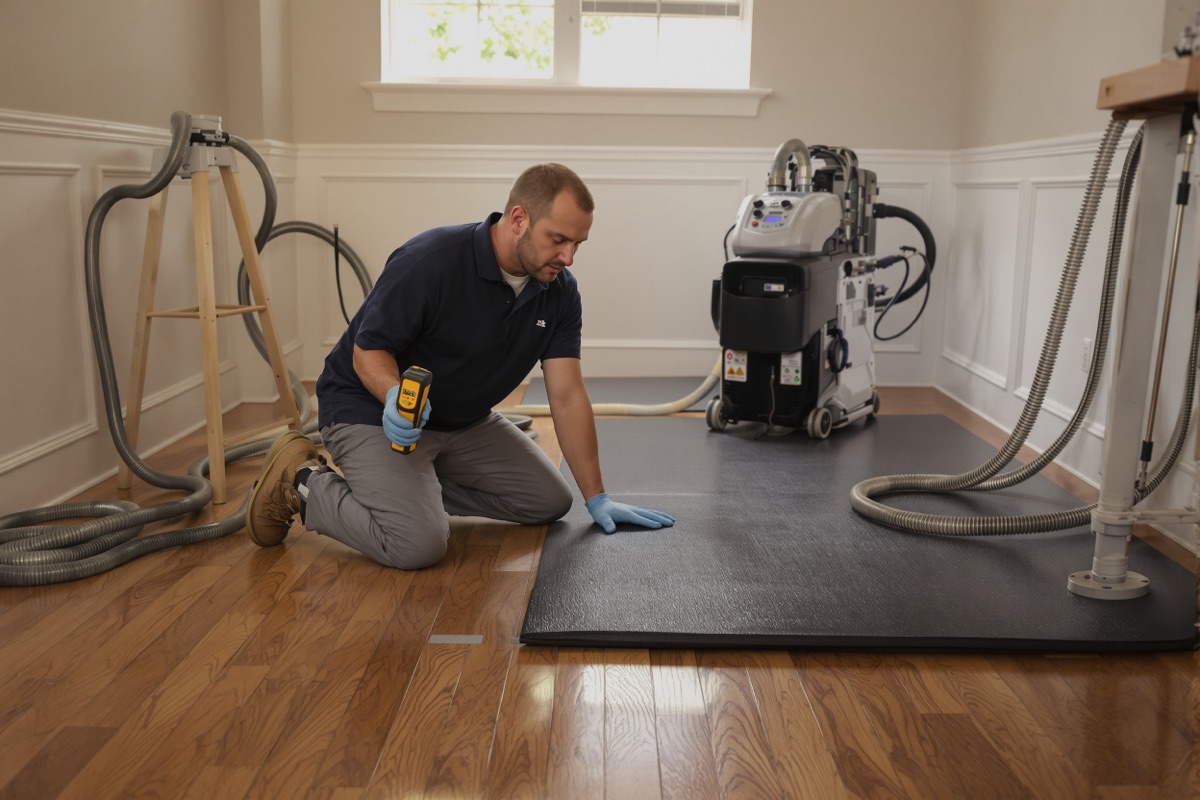
Good drying is measured. Before we move anything, we photograph the damage and take moisture readings in every affected room, plus a dry reading from an unaffected part of the house as a baseline. Thermal imaging cameras show us cooler, wet areas inside walls and ceilings so we open only what needs opening.
Then comes extraction. Extraction comes next, with a truck-mounted rig for heavy water and portable machines for smaller rooms. Deep basement water goes to submersible pumps. Carpet pad, sodden insulation and puffed-up baseboard get removed, since they will not dry well and can hold moisture against the structure.
Drying equipment goes in next. Air movers push air across wet surfaces, and commercial dehumidifiers pull the moisture out of the air so it does not just move from the floor to the walls. We come back every day, take new readings, record them in the drying log and adjust equipment. When everything reads within normal range of the dry reference, the drying is complete.
Most homes take a few days. Plaster, hardwood and masonry walls take longer. We tell you what to expect at the start and update you as the numbers change. That steady, documented approach is how we handle Maplewood water damage restoration in every kind of house, from a small cottage to a large colonial.
Mold in basements that have been damp for years
Older basements often have a history. Years of small seepage events, a damp corner nobody worried about, or boxes stored against a cool wall can leave mold growing quietly. Then a bigger water event makes it worse and spreads it.
The EPA’s guide to mold and moisture explains the basic idea well: mold needs moisture, so fixing the moisture is the first step. If removal is called for, mold remediation means closing off the basement area in plastic, pulling it under negative pressure, scrubbing the air through HEPA filters, cutting out the growth and cleaning what remains until it reads dry. Pictures and meter logs record each stage.
If your basement smells musty most of the year, it is worth having it looked at during a dry spell, before the next big storm adds water to the problem.

Maplewood water damage restoration records for your adjuster
Most owners ask about insurance in the first ten minutes. Whether something is covered rests with your policy and your adjuster, so we stay out of promises. What we provide is a clear, honest record of the damage and the work.
We hand over a dated photo set, the moisture numbers for each room and the daily drying record. Read together, they explain the spread of the water, what got soaked, what was taken out and how the numbers fell back to normal. You get a copy for your files. On older homes, those records also capture the original materials, which helps if replacements need to match.
After the last reading, our remodeling team rehangs walls, reinsulates, lays floors, reinstalls cabinets and trim and paints. Maplewood water damage restoration stays with one company the whole way, so no gap opens up between a drying crew and a separate contractor.
Close by
Maplewood shares borders and a lot of history with its neighbors. We also handle water damage restoration in South Orange, leaks and flooded basements in Short Hills and West Orange water cleanup. Our full service areas list covers the rest of North Jersey, and our main water damage restoration page walks through each service.
Frequently asked questions about Maplewood water damage
My Maplewood home has plaster walls. Will you have to tear them out?
Not always. If the plaster is still firmly attached and the water was clean, we often dry it in place. We test it with moisture meters and check its condition first. Plaster that is loose, sagging or touched by contaminated water has to come out.
We live near the Rahway River. Does that change anything?
It can. Homes near a river branch or in low areas may see groundwater or storm water. Floodwater from outside is treated as contaminated, so more porous material is removed. Check your address on the FEMA flood map to understand your risk.
Our street backs up to South Mountain Reservation and the basement gets wet in storms. Why?
Wooded slopes and clogged gutters can send extra water toward houses below. Check gutters and downspouts, extend downspouts away from the foundation, and look for standing water after storms. If water gets in, call us to dry it before mold starts.
Can old hardwood floors be saved?
Often, if we start drying quickly. We aim drying at the floor and subfloor and track the boards daily. Some floors settle flat as they dry. Others need sanding and refinishing, which our crew can handle during the rebuild.
Do you work with my insurance company?
Your adjuster gets our complete photo and moisture record. What the policy pays for is their call to make.
Will you rebuild the room afterward?
Yes. Walls, floors, cabinets, trim and paint all go back in, and we try to match original details in older homes.
Pick up the phone, we will handle the rest
Shut off the water if you can, keep away from anything electrical near the water, and phone (973) 992-4400. There is no after-hours voicemail here: the line is answered all year, and help is dispatched while you are still on the call. DryMax is locally owned and has worked in Maplewood and the rest of North Jersey since 2018. You can read more about us here.