
Saddle River is a borough built around open land, old houses and a river, and Saddle River water damage restoration has to account for all three. It is a town known for its fields, farmland, horse farms, forests and rivers, shaped in part by a two-acre minimum lot size. It holds both stately historic homes and newer mansions, and the river that gives the borough its name flows right through it.
We are DryMax Water Restoration, a locally owned company serving Essex, Morris, Bergen, Passaic and Hunterdon counties since 2018. Our team is IICRC certified. Our line at (973) 992-4400 is answered by a person 24 hours a day, 365 days a year, holidays and weekends included. Below, we walk through the kinds of water problems a borough like this one tends to see, and how we handle each kind.
The trout stream that named the borough
The borough takes its name from the Saddle River, which flows through it and feeds into the Passaic River. The New York Times once called it a place where you can still “catch a fish in the trout stream that gives the town its name.” European settlement here goes back to 1675, when land along the river was sold by the Lenape.
A river running through town is a big part of the borough’s character. It is also a source of risk for the homes nearest to it. During long, heavy rains, any river can rise above its normal banks. Properties on lower ground near the water may see wet yards, flooded window wells or water seeping into basements as the ground becomes saturated.
River water is not clean water. It carries soil, debris and whatever was picked up upstream, so it is handled as contaminated. Porous materials that it touches are usually removed, and hard surfaces are cleaned and sanitized before drying starts. If you live near the river, the federal Ready.gov flood page is worth reading now, while the water is low, so your family has a plan for high water.

Two acres and up: when nobody sees the leak
The two-acre zoning that gives the borough its countryside feel also means houses sit far apart and often far back from the road. That privacy is the point. It also means nobody next door is going to notice water pouring out of a basement window or a garage door.
On big lots, problems tend to be discovered late. A slow leak in a wing of the house you rarely use, a failed sump in a basement you only visit to change a filter or a burst pipe in a detached garage can run for a long time. By the time you find it, the water may have spread through several rooms, soaked into framing and started to smell.
Large properties also make equipment logistics matter. Long driveways, gated entries and homes set deep on a lot all affect how quickly we can get pumps, hoses and extractors to the water. When you call, tell us about access, such as gate codes or the best door to use, so the crew can get to work as soon as they arrive.
Water sensors with phone alerts, placed near the water heater, the washing machine and the sump, are a simple step that can make a big difference on a property this size. They do not stop a leak, but they shorten the time between the first drop and the first phone call.
Historic houses on the National Register
More than twenty properties in the borough are on the National Register of Historic Places, including several Ackerman family houses, the Hopper House, the Van Buskirk houses and the Saddle River Center Historic District. Beyond those landmarks, the borough has many other older homes and estates.
Older and historic houses need a gentler hand when water gets in. Original plaster on wood lath holds moisture longer than drywall and can look dry while it is still wet inside. Old-growth wood floors and trim are often irreplaceable, so saving them is worth extra drying time. Stone foundations let moisture move through slowly, which can keep a basement damp long after the standing water is gone.
Our approach in these homes is to measure more and remove less. We take readings in unaffected parts of the house to learn what normal looks like for those materials. We use thermal imaging to find wet areas without opening walls when we can. When something does have to come out, we photograph it first so the rebuild can match it.
For a historic home, Saddle River water damage restoration is about protecting what cannot be replaced while still getting the structure fully dry. Rushing that process, or sealing walls before they are ready, is how mold and rot end up hiding behind new paint.
Newer estates with a lot of plumbing
Alongside the older homes, the borough has newer mansions. Large new houses often have many full bathrooms, more than one laundry room, a kitchen with several water lines, a wine room, a home spa or a pool equipment room. Each fixture and appliance is a possible leak.
In these homes, the most damaging leaks tend to start upstairs. A supply line under a bathroom vanity, a steam shower valve or a washer on the second floor can send water down through two finished levels. The ceiling below shows a stain, but the water has already traveled through the floor system, insulation and wall cavities on its way down.
Modern materials can also make drying harder. Spray foam insulation, engineered floors and large-format tile over a membrane can trap moisture. That is why our moisture map matters so much. Pin and pinless meters, along with a thermal camera, show us where the water actually went, not just where it showed up.
Horse farms, barns and guest houses
Horse farms are part of the picture here too. Horses still have room here, and the New York Times once noted that in Saddle River you can keep one per acre. A property with horses, a barn or a separate guest cottage has more buildings with plumbing to worry about.
Barns and outbuildings may have water lines for stalls, wash areas or a small apartment. They are often heated less than the main house, or not at all, which makes them more likely to freeze in winter. A frozen line in a barn apartment, a pool house or a detached garage can flood the space before anyone walks out to check it.
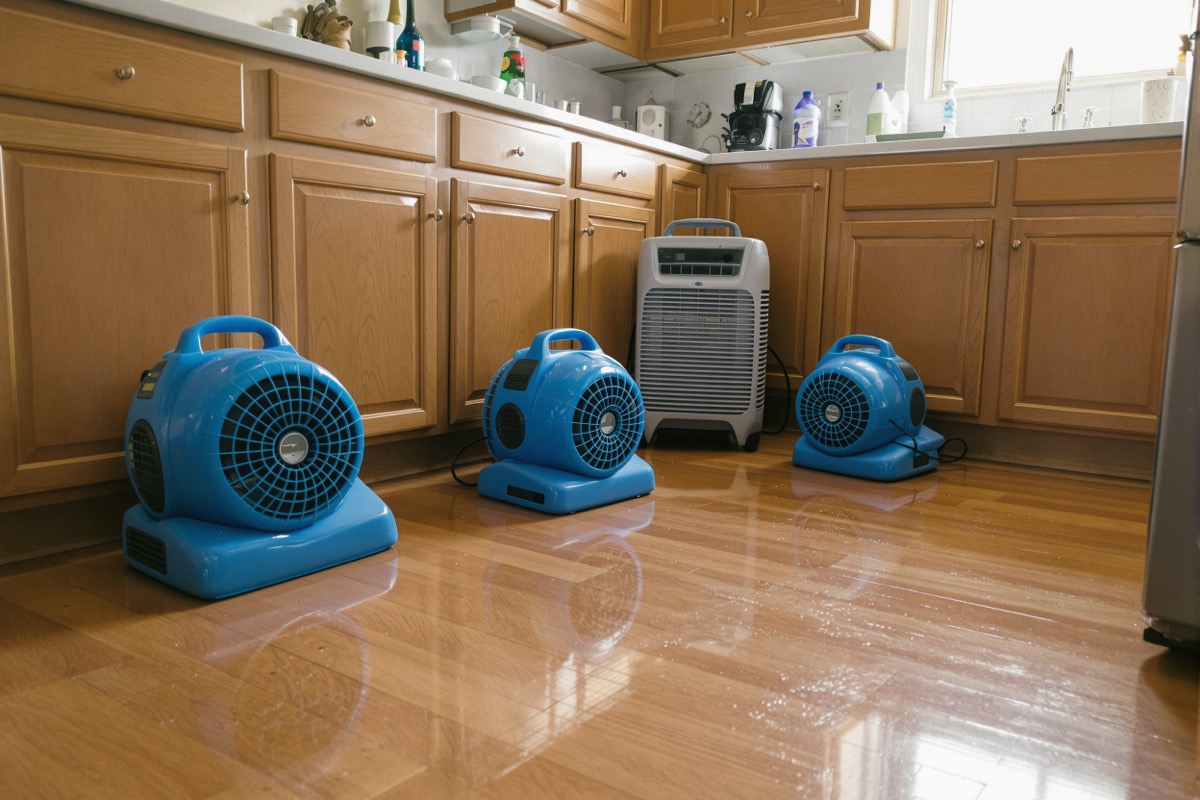
We handle water in these buildings just as we do in the main house: extraction, moisture mapping, removal of wet materials that will not dry and structural drying with air movers and dehumidifiers. If the building is used as living space, we can rebuild it afterward too.
When the house sits empty
On a property this size, a trip away from home for a week or two can mean nobody looks inside at all. A house left empty, though, is a house where a small leak can turn into a big one.
Before a long trip, it helps to shut off the main water supply or at least the supply to the washer and ice maker. Keep the heat set at a safe level in winter, and ask someone to walk through the house regularly, including the basement and any outbuildings.
If you come home to water, do not try to haul wet carpet or furniture yourself. Shut off the main valve if you can reach it safely, stay away from water near electrical outlets and call us. We move what has to be moved, extract the water and set up drying, and we document everything for your adjuster.
Sump pumps, power and storm season
With forests, fields and a river in the mix, a lot of rainwater moves through the ground here during a long storm. In many homes, the sump pump is the main line of defense for the basement. It is also the part of the house most people never think about until it stops.
Pumps fail for a few common reasons. The float switch sticks. The motor wears out after years of service. A power outage shuts it down right when the storm is at its worst. A discharge line freezes or clogs, so the pump runs but the water has nowhere to go. In a big basement with a home gym, wine storage or a theater, any of those failures can be costly.
A few habits help. Test the pump each spring and fall. Consider a battery backup or a generator that covers the pump circuit. Keep the area around the pit clear so you can see it. If the pump does fail and the basement floods, Saddle River water damage restoration begins with pumping the water out, then extraction, moisture mapping and drying with air movers and commercial dehumidifiers.
Finished lower levels and walkout basements
Homes built on sloped lots often have walkout lower levels, with doors and windows at grade on the downhill side. Those spaces get finished as family rooms, guest suites and home offices, with carpet, drywall, built-in cabinets and wood trim.
A walkout has more openings for water than a standard basement. A clogged drain at the base of an exterior stairwell, a door threshold that sits too low or a window well that fills up can all let water in during a heavy storm. Once inside, water spreads under carpet and wicks up into drywall and the bottoms of cabinets.
We dry these spaces by pulling wet pad, cutting drywall above the wet line when needed, opening cabinet toe kicks and running drying equipment sized to the room. For many families, Saddle River water damage restoration on a lower level ends with our rebuild crew putting the room back together.
Saddle River water damage restoration, start to finish
First contact
You call, a person answers and we ask what happened, where the water is and how to reach the house. A crew is sent as soon as you call, with equipment already on board.
Assessment and documentation
We look for hazards, photograph every affected area and take baseline moisture readings in wet and dry parts of the home. This becomes the starting point for your drying logs.
Water removal
Deep water goes out through a submersible pump. Carpets, rugs and hard floors are then extracted with truck-mounted or portable units. The more water we remove now, the faster the house dries.
Moisture mapping and removal
Thermal imaging and moisture meters show where the water spread. Anything that cannot dry, like pad, saturated insulation or the bottom of a wall, gets cut out. In historic rooms, we remove as little as possible.
Drying and daily checks
Air movers and commercial dehumidifiers run until readings reach normal. We return every day to check, adjust and record. When it is dry, the equipment comes out and you get the full record. Our water damage restoration page explains each step in more depth.
Whether a loss is covered is your insurer’s call, based on your policy. Our part is giving the adjuster clear photos, readings and drying logs.
Mold in big, quiet spaces
Mold likes the parts of a house nobody visits: a closed guest suite, an attic, a crawl space, the back of a closet in a pool house. When water sits in those places for more than a day or two, mold growth can start before anyone notices.
Our mold remediation process isolates the room in plastic under negative air so the rest of the home stays clean, runs HEPA air scrubbers, removes materials that cannot be cleaned, HEPA vacuums and cleans the remaining surfaces and dries the area. We confirm the work with moisture readings, photos and thermal images. In a large home, containment lets you keep using the rest of the house while one area is being treated.
Rebuilding to the standard of the home
After the water is gone and the structure is dry, the house still needs to look the way it did. In a borough with this many custom and historic homes, that means real attention to detail. Our remodeling crews replace drywall and insulation, paint, install flooring and reinstall trim and cabinets, using the photos from day one to match what was there.
Keeping the drying and rebuild with one company makes the job easier for you. There is one point of contact, one schedule and one set of records from the first call to the finished room. For larger properties with offices or commercial spaces, see our commercial water damage service as well.

Frequently asked questions about Saddle River water damage
Do you work on historic homes in Saddle River?
Yes. We dry older and historic homes carefully, measuring plaster, wood and stone against dry areas of the same house and removing as little original material as possible.
Our basement took on water when the river was high. What should we do?
Stay out of standing water if outlets or appliances are submerged, and call us at (973) 992-4400. River water is treated as contaminated, so the soft materials it reached get thrown out and the hard ones get sanitized before drying.
Can you handle water in a barn apartment or pool house?
Yes. Outbuildings get the same extraction, moisture mapping, drying and documentation as the main house, and we can rebuild living spaces afterward.
We came home from a trip to a burst pipe. Where do we start?
Shut the main water valve if you can safely reach it, take a few photos and call us. We extract the water, clear the wet area and set up drying, and we document every step for your adjuster.
How do you get equipment to a house set far back on a big lot?
Portable extractors and pumps can be carried in where a truck cannot reach. Let us know about gates, driveways and the best entry when you call, and the crew will plan around it.
Will insurance pay for the damage?
Your insurer decides coverage based on your policy and the cause. We supply photos, moisture readings and drying logs so the adjuster has what they need.
One call for Saddle River water damage restoration
Water in a historic house, a new estate, a barn or a guest cottage needs fast attention. Call (973) 992-4400 any time. We also serve nearby towns, including water damage restoration in Ridgewood, Wyckoff water damage cleanup and Franklin Lakes water damage help. See the full list on our service areas page.