
Water inside a hillside house almost never sits still. DryMax provides Montclair water damage restoration at any hour, starting with the first pump in a flooded basement and finishing with fresh paint on rebuilt walls. Our technicians carry IICRC certification, the company has been locally owned since 2018, and somebody picks up the phone on every holiday and every weekend night.
Montclair sits on the east side of the First Mountain of the Watchung Mountains. That single fact explains a lot of what we see. Rain lands on the ridge, runs downhill through yards and streets, and looks for the lowest opening it can find. Very often that opening is a foundation wall, a basement window well or a floor drain that cannot keep up.
Montclair water damage restoration on the First Mountain slope
A town built on a slope has a different water problem than a flat one. Homes near the top of the hill deal with runoff that picks up speed as it travels. Homes lower down catch what the upper streets send them. In between, a driveway that tilts toward the garage or a patio that drains toward the house can push water straight into a finished lower level.
Montclair gets about 50 inches of rain a year, above the national average of 39. Add roughly 30 inches of snow from December into March, and you have a lot of water moving across the township in every season. A clogged gutter on a steep lot can dump gallons against one corner of a foundation in a single storm.
We start every Montclair job by asking where the water came from, because the answer changes how we dry the space. Groundwater seeping through block walls behaves differently from a supply line that let go behind a dishwasher. Runoff can carry soil and debris. A sewer backup carries contamination and calls for a different level of cleaning and protection.
Neighborhoods such as Upper Montclair, Watchung Plaza, Frog Hollow, the South End and the Church Street area, each sit at a different point on that slope. We do not assume a house will behave like the one next door. We measure it.
Five brooks, two rivers and your basement
Few towns this size have as many named streams. Toney’s Brook runs through the center of Montclair, Nishuane Brook through the southeast, Wigwam Brook through the southwest, Pearl Brook through the northwest and Yantacaw Brook through the northeast. All of them flow east and belong to the Passaic River watershed.
Wigwam, Nishuane and Toney’s brooks feed the Second River. Pearl and Yantacaw feed the Third River. Yantacaw and Toney’s brooks are dammed in parks to form ponds. Those are pleasant features on a walk, and they also mean that some properties sit close to moving water and the soggy ground that comes with it.
If your home is near one of these brooks, a wet basement after heavy rain may not be a plumbing failure at all. The soil around the foundation can stay saturated for days, and hydrostatic pressure pushes moisture through cracks, cove joints and old mortar. If your pump never seems to rest while it rains, the soil around your house is holding all it can.
When that pump stops, the water rises fast. Submersible pumps and truck-mounted extractors clear the standing water first. After that, a ring of air movers and a few commercial dehumidifiers work on the slab, the bottom plates and the lower drywall. Our technicians check readings daily until the materials are back to a dry standard. That daily check is the part of Montclair water damage restoration that keeps a wet basement from turning into a mold problem a month later.
For homeowners who want to understand their flood exposure, a quick search on the FEMA flood map service shows how your street is mapped. Brook-side households in particular may want to look before storm season.
Historic houses and the leaks you cannot see
Montclair is noted for its historic architecture. The township has six historic districts on the state and national registers and 92 individually listed landmarks. Many older houses in town have plaster walls, original wood floors, deep window trim and basements that were dug long before anyone planned to finish them.
Older construction hides water well. Plaster can look fine while the lath behind it is soaked. Water from an upstairs bathroom can travel along a joist and show up as a stain two rooms away. Wide plank floors cup slowly, so by the time you notice the boards lifting, the subfloor may have been wet for weeks.
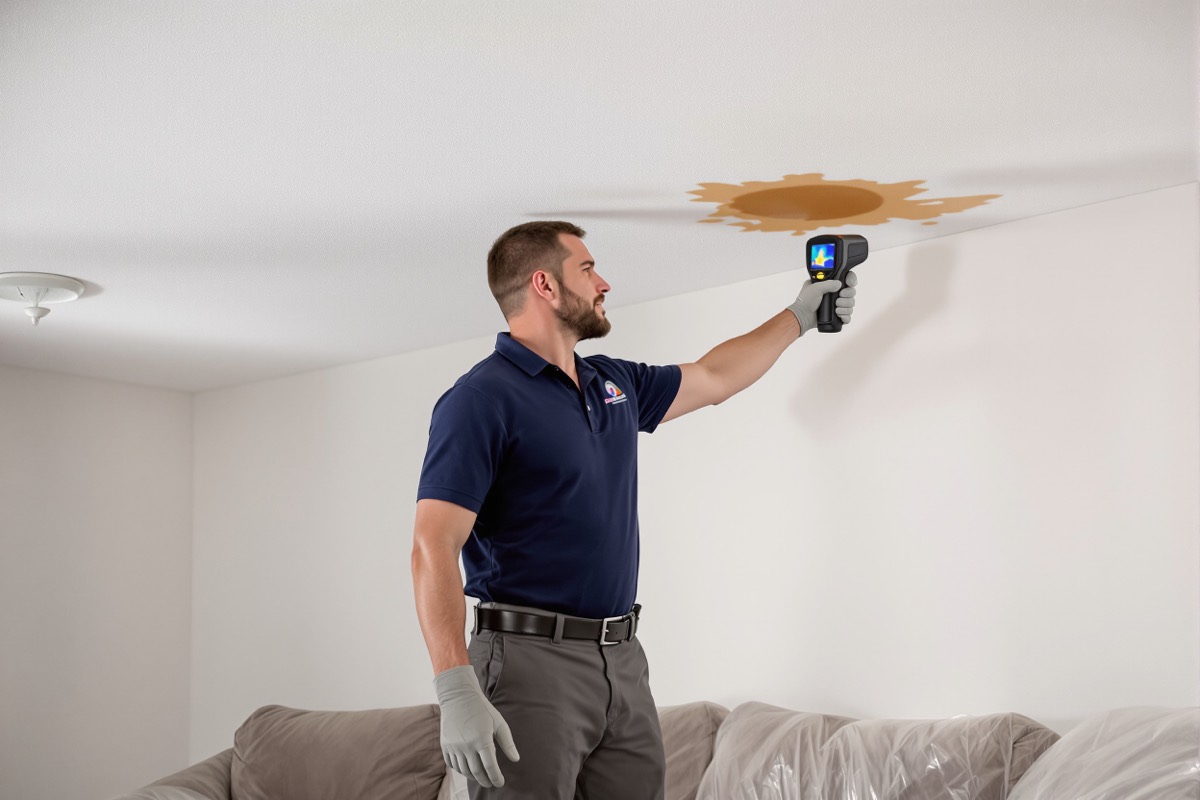
Our crews follow the water with thermal cameras plus pin and pinless meters, so nobody is guessing. On a historic home, that matters. Finding the edge of the wet area lets us remove only what has to go and save original trim, flooring and plaster wherever the readings say they can be dried in place.
Large older homes in town often have bathrooms on two or three floors and laundry rooms moved upstairs during later renovations. A failed washer hose on a second floor sends water down through every level below it. We trace it floor by floor, open ceilings only where the meters point, and dry each level as its own job.
Porches, sunrooms and kitchen bump-outs added over the years deserve a look too. Where a newer addition meets the original house, flashing and framing do not always line up perfectly, and water can find its way into the seam. Stains near those joints are often the first clue.
Signs worth a call
- A ceiling stain that grows or changes shape after rain or a shower.
- Paint bubbling on a basement wall or along a baseboard.
- Hardwood that has started to cup or crown near a kitchen or bath.
- A musty smell that returns no matter how often you air the room out.
January on the ridge: frozen and burst pipes
Montclair’s January lows average about 21 degrees Fahrenheit. Nights like that can freeze plumbing inside an outside wall, under an enclosed porch or along a drafty sill. Older houses with additions built at different times often have runs of plumbing in spots that were never insulated well.
A frozen pipe usually does not leak until it thaws. So the trouble often shows up on the first mild afternoon following a deep freeze, or when someone gets back from vacation and hears dripping above the kitchen. Close the main valve, kill power to soaked rooms only when you can do it without stepping in water, then pick up the phone.
A crew heads out the moment we hang up. Their first job is stopping the spread, then pulling up standing water and tracing dampness through walls and floors. Because water from a burst line is usually clean at first, fast drying gives you the best chance of saving materials before bacteria and mold have time to grow.

What happens after you call
Your call goes to a person, day or night. We ask a few quick questions about where the water is, how long it has been there and whether it might be contaminated. Then we get a crew moving.
On arrival, the team walks the property with you, finds the source and makes sure it is stopped. Next comes extraction with truck-mounted or portable units, depending on how much water there is and how far the truck can reach on a hillside driveway.
With the floor cleared, the readings become the drying plan. Air movers push moist air off surfaces, and commercial dehumidifiers pull it out of the room. Sometimes a strip of wallboard comes off just above the waterline to let air into the stud bay. Every reading is logged so you can see the numbers fall day by day.
We stay with the job until the moisture readings match dry reference points in unaffected areas of the house. Only then do we pull equipment and move on to repairs. Every stage is laid out on our water damage restoration page.
When a floor drain backs up
Heavy rain does not only push groundwater toward a foundation. It can also overwhelm sewer lines, and in a lower level that shows up as dark water coming out of a floor drain, a basement toilet or a laundry sink. That water is contaminated and should be treated that way from the first minute.
Keep kids and animals upstairs, stay off the wet floor, and skip the mop and shop vacuum. Our technicians suit up, pump out the mess, tear out anything absorbent that sewage reached, and disinfect the remaining surfaces before the dehumidifiers go on. Soaked padding, wallboard near the floor and fiberglass batts that sewage touched generally get bagged and hauled away.
Sewage cleanup is part of Montclair water damage restoration we take seriously, because it affects the health of the people living in the house. Each item we tear out is photographed and noted, giving the adjuster the reason behind every decision.
What to do before the crew arrives
- Close the main valve when a pipe or fixture is the culprit.
- Flip breakers for flooded rooms only from a dry spot.
- Move photos, documents and small furniture to a dry floor.
- Take a few pictures of the damage on your phone.
- Leave wet drywall and flooring in place so we can measure it.
Those few steps limit the spread and make it easier for us to see what happened. Everything else, from moving heavy furniture to pulling baseboards, can wait for our team.
Mold after a leak in an older Montclair home
Mold growth comes down to three things: dampness, something organic to eat and enough days. Older Montclair houses have plenty of wood, paper-faced drywall and dust to feed it, so the real variable is how long things stay wet. A small, slow leak inside a wall can do more damage over a season than a dramatic burst pipe that gets dried within days.
Where we find colonies, the room gets sealed in plastic sheeting with a negative air machine exhausting it, which keeps spores out of the rest of the house. Moldy drywall or trim comes out, the framing is HEPA vacuumed and wiped, and HEPA scrubbers filter the air during the work. Proof of a finished job comes from final meter readings, photographs and thermal scans. Details live on the mold remediation page.
The key to stopping mold for good is fixing the moisture that caused it. That might mean drying a basement after a brook-side storm, correcting a slow drip under a sink or addressing runoff against a foundation. We point out what we find so you can decide what to do next.
Putting the room back and documenting the claim
Dry is not the same as finished. Our own carpenters and finishers hang the board, replace insulation, lay floors, paint, run trim and set cabinets. Keeping it under one roof spares you from hiring a separate contractor and hoping they read the drying crew’s notes.
Old houses deserve a careful match. That can mean trim profiles, the look of a plaster wall or how a floor transitions between rooms. Our remodeling page covers the rebuild side of our work. For many families, the finished room is the part of Montclair water damage restoration they remember most.
A running file of pictures, meter numbers and daily drying logs is kept from day one, and it is yours to pass along to the adjuster. Coverage is decided by the policy wording. What we supply is a dated, organized record that makes that review easier.

Storefronts, offices and Montclair Center
Montclair Center, also called Downtown Montclair, is the township’s main commercial zone. Shops, restaurants and offices in older mixed-use buildings face their own risks: a tenant upstairs with a leaking fixture, a roof drain that backs up, or a basement storage area that takes on water in a storm.
For businesses, every closed day costs money. Where possible we schedule around opening hours, wall off the work zone with plastic, and hand owners and managers a clean job file. Our commercial water damage page has more detail.
Next door in Glen Ridge, Verona and Cedar Grove
Montclair borders Bloomfield, Cedar Grove, Glen Ridge, Orange, Verona and West Orange in Essex County, plus Clifton and Little Falls in Passaic County. Our crews cover all of Essex, Morris, Bergen, Passaic and Hunterdon counties.
Have a relative or an investment property close by? We also provide water damage restoration in Glen Ridge, water damage cleanup in Verona and flood and leak help in Cedar Grove. Browse the full map on our service areas page, and meet the company on the about page.
Frequently asked questions about Montclair water damage restoration
No pipe broke, so why is my basement wet? We live near one of the brooks.
Ground beside Toney’s, Nishuane, Wigwam, Pearl or Yantacaw Brook can stay soggy for days after a downpour, and that pressure forces seepage through old mortar and slab cracks. We pump it out, dry the room and point to the spots where the meters say it enters.
Is my original plaster and trim a lost cause?
Usually not. Thermal scans and meter readings show the true edge of the wet zone, and anything inside it that can recover is left on the wall and dried. Removal is limited to pieces the numbers rule out or that already show growth.
How fast do you start Montclair water damage restoration after I call?
The line is staffed all night, and a truck is dispatched right after we talk. Stopping the leak, clearing the water and getting dehumidifiers running come first.
Is this something my homeowners policy pays for?
Only your policy can answer that, and the cause of the leak matters. Our job file of images, readings and logs gives the adjuster solid ground for a decision.
Who puts the walls and floors back?
We do. The same company that dried the house rebuilds it, so there is no second contractor to find.
Do you work on businesses in Montclair Center?
Yes. Storefronts, offices and apartments over shops are all part of our commercial work, planned to keep customers and tenants as undisturbed as possible.
Call DryMax now
Water on the floor, a stain on the ceiling or a basement that smells wrong will not wait for business hours, and neither do we. For Montclair water damage restoration, dial (973) 992-4400. A live voice answers whether it is noon on Tuesday or three in the morning on New Year’s Day.