
Morristown packs more than three centuries of building into about three square miles, and water treats every era of that building stock differently. This page lays out Morristown water damage restoration as we practice it: what tends to go wrong in historic homes, dense downtown buildings and storefronts, how we dry each one, and how we put the space back together afterward. We are an IICRC certified, locally owned outfit that opened its doors in 2018, and a person answers our line, (973) 992-4400, around the clock on every day of the calendar.
Your first hour, step by step
Start with the shutoff. If a pipe, fixture, appliance or water heater is leaking, close the valve closest to it or the main where the line enters the building. In an apartment or condo, the main may be in a utility closet, a basement room or a mechanical space your building manager controls.
Next, think about electricity. Do not walk into standing water near outlets or cords. If the breaker panel is reachable from a dry spot, cut power to the wet area. Move valuables, papers and electronics up and away, and snap a few photos before anything is moved too far.
Then call (973) 992-4400. You reach a live dispatcher who asks a few quick questions and gets technicians rolling. Early extraction is the single biggest factor in how much Morristown water damage restoration a building ends up needing, so do not wait to see if it dries.
Morristown water damage restoration in a town with deep history
Morristown was settled around 1715 and became the seat of Morris County in 1739. It is famous for its role in the Revolution, and the town’s history is still visible in its streets. A historic district covering much of the center was added to the national register in 1973 and expanded in 1986.
That history is wonderful to live with. It also means many buildings have stone or brick foundations, old plaster, decades of plumbing updates layered on top of each other, and framing that previous owners have cut into and patched repeatedly. Water in those assemblies does not always go straight down. It follows beams, pipes and old chases, and it can surface far from where it started.
Morristown is also unusual on the map: it is completely surrounded by Morris Township, one of the state’s so-called doughnut towns. Because the town line is never far from the center, the same older housing and the same drainage patterns usually continue right across it. Water problems ignore the border, and so do we.
Our first step in any older building is careful observation. We trace the visible damage back toward the source, scan with a thermal camera, and confirm with moisture meters before deciding what has to come out.
Gilded Age estates and Victorian houses
Between 1880 and 1929, dozens of large country estates went up in Morristown and the surrounding township. Acorn Hall, an 1853 Victorian Italianate mansion, and the 1807 Sansay House on DeHart Street are reminders of how long many local buildings have been standing.
Large old houses have a few water habits of their own:
- Plumbing that was added long after construction, sometimes running through spaces never designed for it.
- Bathrooms and laundry areas added on upper floors over plaster ceilings and decorative trim.
- Boilers, radiators and steam or hot-water heating lines that can leak at fittings and valves.
- Stone foundations that let groundwater seep through mortar during long rains.
- Attics and roof valleys where ice and wind-driven rain find their way in.
Saving original materials matters to people who own these homes. Plaster, hardwood and old millwork can often be dried in place if we get to them quickly and monitor them closely. If a piece must go, you hear the reason first, it gets photographed, and the cut stays as small as practical.
Large houses also tend to hide leaks well. A slow drip from an upstairs bathroom may travel down an interior wall, along a beam and into a room you rarely use. Thermal imaging is especially useful here, because it lets us scan wide areas quickly. For Morristown water damage restoration in a big older home, that scan often finds wet areas that the homeowner never suspected.
Shared walls, stacked units and the leak from upstairs
Morristown is dense. More than 9,200 homes fit into about three square miles, many of them in buildings where neighbors live above, below or beside each other.
When units share walls and floors, one leak can become everyone’s problem. A failed washing machine hose, a toilet supply line or a cracked shower pan in one unit can soak the ceiling in the apartment underneath and travel sideways through shared wall cavities. Sometimes the person whose ceiling is dripping is the first to know, while the source upstairs is quiet.
Morristown water damage restoration in a multi-unit building means coordinating with several people at once: the owner or tenant where the leak started, the neighbors affected, and often a property manager or association board. We map moisture in every affected unit, document each one separately, and set equipment so drying in one space does not disrupt another more than necessary.
If water is coming through your ceiling from a neighbor’s unit, let the building manager or the neighbor know right away so the source can be shut off. Then call us. We can begin extraction and drying in your unit even while the source is being repaired upstairs.
Water heaters and appliances in tight spaces
In apartments, condos and townhouses, water heaters and washers often sit in small closets next to finished rooms. When a tank fails or a hose bursts, there is no basement floor drain to catch it. Water spreads under flooring, into carpet and through the bottom of nearby walls.
Clean appliance water is the easiest kind to dry if we reach it early. We pull the appliance when needed, check the subfloor and the walls on every side of the closet, and look below for damage in the next unit down. Your plumber replaces the tank or the line; we handle what the water touched.
Shops and offices around the Green
The downtown shopping and business district is centered on the Morristown Green, a former colonial market square. Storefronts, restaurants, offices and mixed-use buildings ring the area and spread along the streets nearby.
Commercial water damage downtown often comes from sources tenants cannot see: a clogged roof drain, a sprinkler line that breaks, a water heater in a back room, or a leak from an apartment above a shop. Losing a weekend of business can hurt as much as the damage itself.
Our commercial water damage team plans the work around your hours whenever possible. We use plastic containment to separate wet areas from the spaces that can stay open, run quieter setups during business hours when that is safe, and work in phases. Daily drying logs give owners and landlords a clear picture of progress. Commercial Morristown water damage restoration often involves several parties, so we keep the record organized by space and by day.
Humid summers, cold snaps and damp lower levels
Summers in Morristown run hot and sticky, and winters are moderately cold, the classic humid continental pattern. Every season has its own typical emergency.
In winter, pipes along outside walls and in unheated spaces can freeze. The trouble usually appears during the thaw, when a split line starts spraying inside a wall. Older houses with plumbing tucked into exterior walls or crawlspaces are especially prone to it.
In summer, humidity is the problem. Basements that took on any water in spring may never dry on their own once the air outside turns muggy. That is when musty smells, warped flooring and mold growth start to show. A commercial dehumidifier and a proper drying plan fix what a household unit cannot.
Spring storms and long rains in between saturate the soil around foundations. Stone and block walls let that water seep through slowly, and it often shows up as damp carpet or peeling paint along one wall of a finished lower level.
Speedwell Lake, old dams and storm runoff
About 3.26 percent of Morristown’s area is water, including Speedwell Lake, a park with an old dam and ruins. Water is part of the town’s landscape, and in heavy rain, runoff moves across hard surfaces quickly.
In a built-up town, roofs, roads and parking areas shed water fast. Storm drains can be overwhelmed during intense downpours, and water can back up into low entries, basement stairwells and garages. Anything that flows in from the street counts as contaminated water, given what it picks up on the way.
Basement stairwells and below-grade entries are common trouble spots in older parts of town. A drain at the bottom of an exterior stair can clog with leaves, and a single hard storm can fill the stairwell and push water under the door. Morristown water damage restoration after that kind of event includes cleaning, since the water came from outside, and drying the walls and flooring it reached.
If heavy rain is coming, Ready.gov has straightforward flood safety advice, including staying out of moving water and away from electrical hazards. Once water is indoors, ring (973) 992-4400 and we head out immediately.
We measure before we remove anything
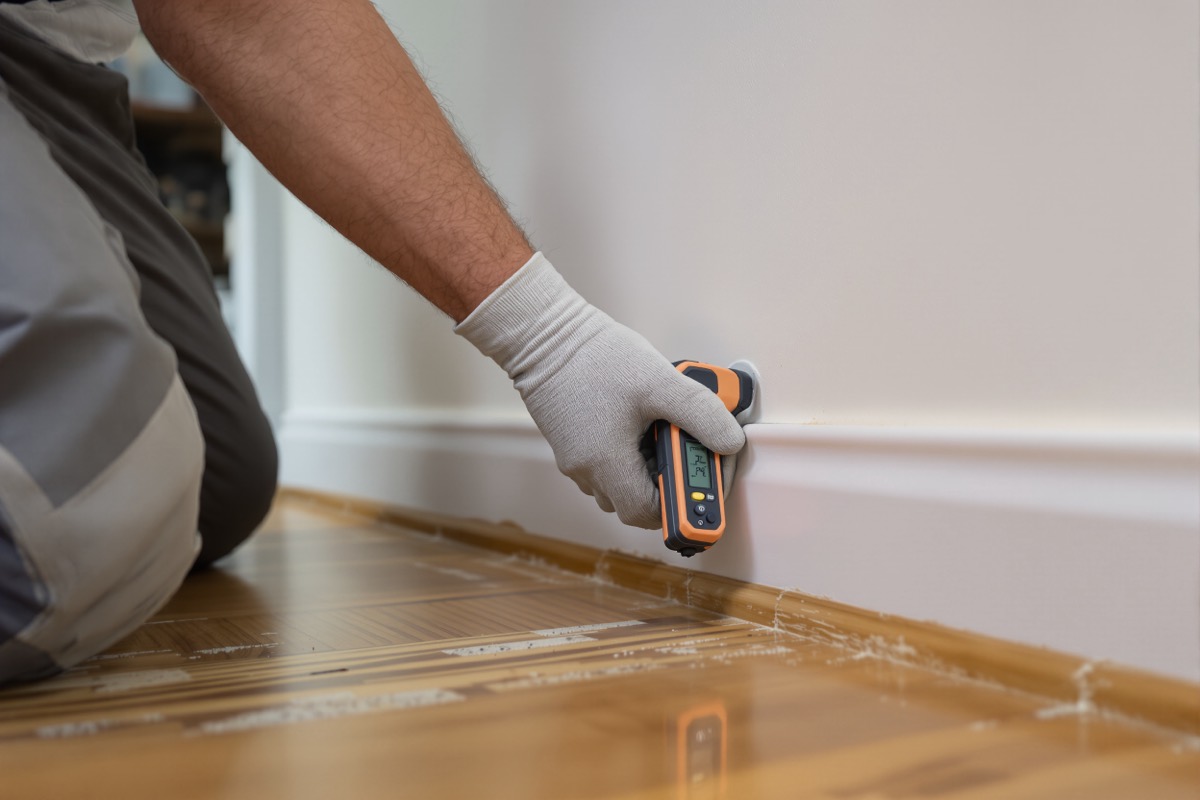
Good drying starts with good data. Each visit begins with a survey: an infrared camera to spot cool, damp zones, then pin-type and pinless meters to put numbers on them, all recorded and photographed. That map tells us where the water went, how far it spread, and which materials can be saved.
Extraction follows. Truck-mounted units and portable wands lift water out of carpet and off hard floors, and submersible pumps deal with deep basement water. Air movers and commercial dehumidifiers take over from there, and we come back daily to read the meters and shift equipment as each surface dries out.
This approach keeps demolition to a minimum. In a historic home, that can be the difference between drying an original plaster ceiling and replacing it. Each stage is explained further in our guide to water damage restoration.
Containment for mold and dirty water
Some jobs need more than drying. When mold has started to grow, or when sewage or storm water is involved, we set up plastic containment and negative air machines so contaminants stay in the work area and out of the rest of the building.

Within that sealed zone, technicians cut out and bag contaminated material, run HEPA vacuums over the exposed framing, wipe it down, keep HEPA scrubbers filtering the air, and finish with drying. On mold jobs, the closing record pairs infrared images with meter numbers and pictures, so you know the cavity is dry before rebuilding starts. Read more about our mold remediation process.
For sewage and sewer backups, porous materials soaked by the backup generally get discarded, and nonporous surfaces get scrubbed and sanitized before the drying phase. Keep kids and pets well away until the cleanup is finished.
Any homeowner recovering from a leak can learn a lot from the EPA’s short mold and moisture guide.
From dry to done
Drying is only half the job. With dry readings logged, our rebuild crew replaces whatever came out, whether that is wallboard and insulation, a stretch of flooring, cabinet boxes, trim or paint. You keep the same contractor from that first phone call through the final walk-through.
In older homes, rebuilding usually involves matching original details. We take care to fit new trim to old profiles and blend paint so repairs do not stand out. In condos and apartments, we coordinate access with neighbors and building management. Our remodeling page shows how that finish work is handled.
Records for owners, boards and adjusters
We keep a running file on each loss: pictures, meter readings and a day-by-day drying log. That file is yours to pass to an adjuster, an association board or a landlord.
Insurers, not contractors, decide what a policy pays for. In shared buildings, more than one policy may be involved. A clear, unit-by-unit record helps everyone see what happened and what was done.
Morristown water damage restoration in surrounding towns
Morris Township wraps all the way around Morristown, and our crews work throughout that ring and well beyond it, into Essex, Bergen, Passaic and Hunterdon as well as the rest of Morris County.
Nearby, we offer water damage restoration in Madison, water damage restoration in Mendham, and water damage restoration in Harding. The service areas list shows every community on our map, and our about page tells you who we are.
Frequently asked questions about Morristown water damage
Can you dry plaster walls and ceilings in an older Morristown home without tearing them out?
Often, yes. Old plaster releases water slowly, so the job runs a bit longer and gets checked more often. We compare it against dry reference spots elsewhere in the house and leave the dehumidifiers on until it matches. If plaster has failed or is contaminated, we explain why it has to come out.
Water is coming through my ceiling from the unit above. What should I do?
Tell your neighbor or building manager right away so the source can be shut off, move belongings away from the drip, and call (973) 992-4400. We can extract and dry your unit while the source is repaired and document your space separately.
Can you work in a shop or office near the Green without closing it?
In many cases, yes. Containment separates wet areas from usable ones, and we can phase the work around your hours where it is safe to do so.
Our boiler leaked into the basement. Is that clean water?
Water from a heating system is usually not sewage, but it can carry rust and sediment, and it often soaks materials that sit for a while before anyone notices. We extract it, check how far it spread and dry the area. Your heating contractor handles the boiler itself.
Will my insurance cover the damage?
Your insurer reads the policy and makes that determination. We supply the facts it needs: dated images, room-by-room moisture numbers and our daily drying notes.
Do you rebuild after drying?
Yes. Wallboard, insulation, floors, cabinetry, millwork and painting are all handled in-house, so nothing gets handed off to a stranger.
One call gets us moving
Whether it is a historic house, a downtown apartment or a shop on the Green, water damage does not wait. Dial (973) 992-4400 and talk to DryMax now. Holidays and overnight hours are covered, and technicians leave as soon as we hear from you.