
Finding water where it does not belong is stressful, and the questions come fast. How bad is it, what do I touch, who do I call? This guide to North Caldwell water damage restoration answers those questions in order, starting with what to do right now and working toward the rebuild. DryMax Water Restoration is an IICRC certified, locally owned company serving North Jersey since 2018, and our phone at (973) 992-4400 is answered around the clock, 365 days a year.
The first ten minutes after you find water
Before anything else, think about safety. If water is near outlets, a panel or anything plugged in, stay out of it and shut power to that area at the breaker only if you can reach it from a dry spot. If you cannot, wait for us.
Then stop the source if you can. For a supply line, a water heater or a toilet, that usually means closing the fixture valve or the main shutoff where the water line enters the house. For rain or groundwater, there may be nothing to close, and that is fine. Move rugs, electronics and boxes off the wet floor if it is safe.
Take a few quick photos with your phone. Wide shots of each room and close shots of the source help later. Then call (973) 992-4400 and tell us what you see. Day or night, a person picks up, and a truck gets loaded while you are still describing the problem.
Skip the household fans and the shop vacuum marathon. They rarely move enough water or air to make a difference, and they can spread dirty water into clean areas.
One more tip: resist the urge to pull up carpet or tear out drywall on your own. Removing materials before they are photographed and measured can leave gaps in the record your adjuster relies on, and it can make North Caldwell water damage restoration harder to scope accurately.
Living at the top of Essex County
North Caldwell is a borough in the northwestern corner of Essex County, and it holds the county’s highest point. That spot sits in the Hilltop section at 691 feet. It is a striking fact, and it tells you a lot about how water behaves across the borough.
Height helps in one way. Very little of North Caldwell is open water; only about 0.16 percent of the borough is water. River flooding is not the everyday worry it is in some lower towns.
Height also creates its own risks. Rain that falls on high ground has to go somewhere, and in a hilly borough it moves downhill across lawns, driveways and foundations on its way to lower ground. Homes partway down a slope can collect runoff from every property above them.
Wind is the other factor at elevation. Driving rain hits exposed walls harder, and water can be pushed past window flashing, around door thresholds and under siding. The result often shows up as a stain under a window or a soft spot in a floor near an exterior door.
Water on the way down the slope
North Caldwell was once part of the Horseneck Tract, a large purchase that stretched across western Essex County from the First Mountain down to the Passaic River. The borough still sits on that same general fall of land. Water follows it.
On a sloped lot, the uphill foundation wall takes the most pressure from saturated soil. Water can seep through mortar joints, tie holes or hairline cracks and run down the inside face of the wall, out of sight behind finished drywall. The first clue is often a musty smell, a swollen baseboard, or carpet that feels damp along one wall.
Downspouts that empty right at the foundation make it worse. So do patios and walkways that slope toward the house. We note these things during our visit because they explain why one corner keeps getting wet, though correcting grading or gutters is a job for the right contractor.
Snowmelt follows the same path. When a deep snow pack melts over a few warm days, the slope delivers that water to foundations for a week or more. For North Caldwell water damage restoration after a thaw, we pay close attention to the bottom plate of finished walls and the underside of carpet pad, which stay wet long after the surface feels dry.
Sump pits, lower levels and power outages
Many homes on sloped ground rely on a sump pump to move groundwater away from the lower level. When it works, nobody thinks about it. When it fails, the basement can take on water quickly.
The usual failure points:
- A power outage during a storm, which is exactly when the pump is needed most.
- A stuck float switch that never tells the motor to start.
- A pump that is simply too small for the volume of water reaching the pit.
- A clogged or frozen discharge line that sends water back into the pit.
- An older pump that has quietly worn out.
If the lower level is finished, a sump failure soaks carpet pad, the bottom of the drywall, insulation and sometimes the bottom of cabinets or a bar. We pump out standing water, extract the flooring, cut out wet drywall above the waterline where needed, and set drying equipment. Our water damage restoration page covers flooded basements in more detail.

An 1898 borough with newer neighborhoods
North Caldwell became its own borough in 1898, carved out of what was then Caldwell Township and is now Fairfield. A town with that history usually has a range of house ages, and the leaks differ with each one.
Older homes in town may have stone or block foundations, galvanized or older copper supply lines, and walls that have been opened and patched over the years. Water can travel along old framing and appear well away from the leak.
Newer construction brings different problems. One example from the borough’s own history: the former Essex County Penitentiary property, built in 1872, was sold in 2002 and redeveloped into a residential community. Newer homes like those often have finished basements, upstairs laundry rooms, plastic supply lines with push fittings, and tight building envelopes that hold humidity in. A small leak inside a wall of a well-sealed house can stay hidden longer than you might expect.
Whatever the age of your home, the drying math is the same: find all of the wet material, remove what cannot be saved, and run the equipment until the readings say it is done.
Appliance and water heater leaks
Not every flood starts outside. Some of the most damaging leaks come from equipment already inside the house. Water heaters wear out and can fail without warning, often in a finished utility room next to carpet and drywall. Washing machine hoses, dishwasher connections, refrigerator lines and boiler fittings all fail over time.
These leaks are usually clean water at the start, which is good news for drying. The bad news is timing. A slow drip behind a refrigerator or under a dishwasher can run for weeks, soaking subfloor and cabinet bases before anything shows. When we arrive, we pull the appliance if needed, scan the surrounding floor and walls, and dry the cabinets from the inside rather than tearing them out whenever the readings allow.
What the clues in your house usually mean
Homeowners often call with a symptom rather than a source. This quick table matches common clues to the usual culprits. It is a starting point; moisture meters and thermal imaging confirm the real answer.
| What you notice | Common source |
|---|---|
| Brown ring on a ceiling under a bathroom | Toilet seal, shower pan or supply line above |
| Damp carpet along one basement wall | Groundwater or runoff from the uphill side |
| Water around the base of the water heater | Tank failure, relief valve or fitting leak |
| Wet floor near the kitchen sink or dishwasher | Drain, supply line or appliance hose |
| Stain under a window after wind-driven rain | Flashing or sealant letting water in |
| Musty smell with no visible water | Slow hidden leak or high humidity in a closed area |
North Caldwell water damage restoration, step by step
Every home is different, but the order of the work stays the same. Here is how we run a job from the first call. Our approach to North Caldwell water damage restoration does not skip steps, even on small jobs, because the small jobs are where hidden moisture tends to hide.
Assess and map
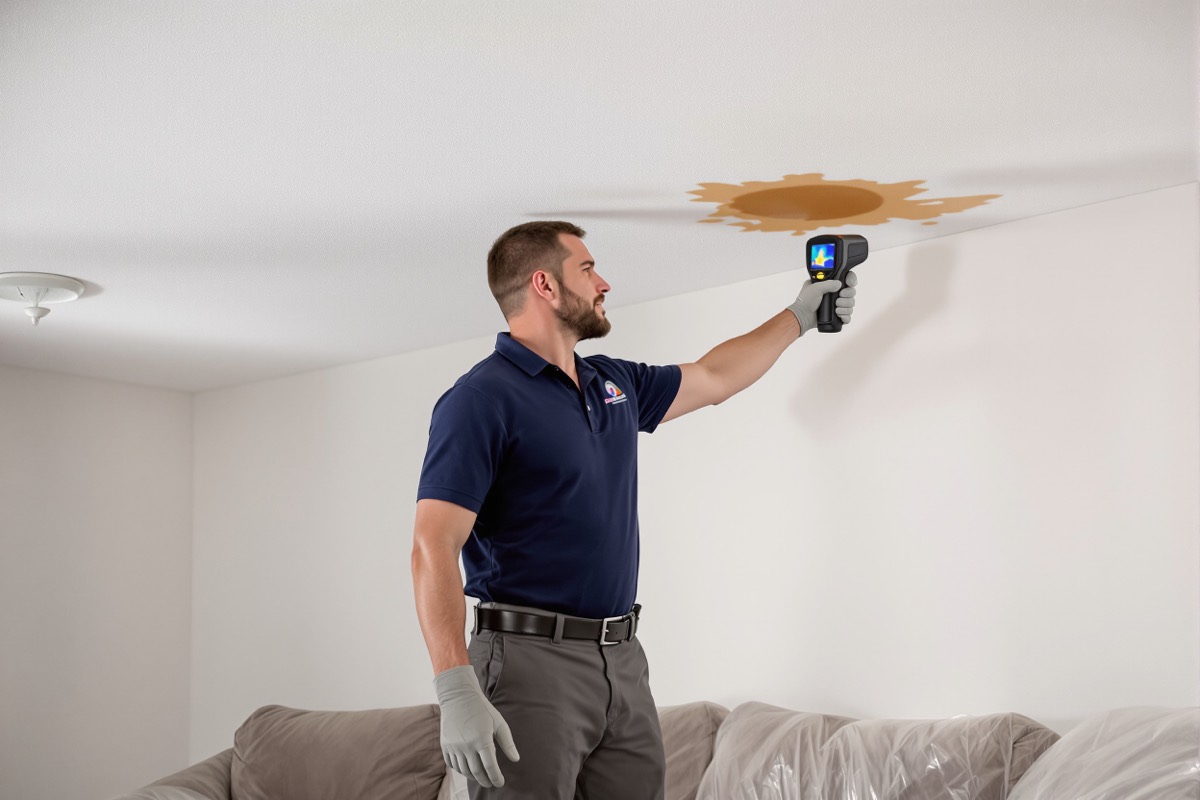
A thermal scan plus pin-type and pinless meter checks let us outline exactly where the wet materials end, with photos of each reading. That map guides the rest of the job.
Remove the water
Our truck-mounted units and portable wands lift water from carpet, pad and hard floors. Submersible pumps handle deeper water in basements. The more water we extract, the shorter the drying phase.
Open up what is needed
Wet drywall that will not dry in place gets a flood cut a short distance above the wet line. Saturated insulation comes out. Baseboards may come off so air can reach the wall cavity. We remove only what the readings say we must.

Dry and monitor
Fans and commercial dehumidifiers keep running until every material tests dry. We check readings daily, log them, and adjust equipment as areas dry out.
Rebuild
Once everything is confirmed dry, we put the space back together. More on that below.
When the water is dirty
Not all water is the same. A burst supply line is clean at first. Water that has run through flooring for a day or two picks up contaminants. A sewer backup or an overflowing toilet with waste is a different category entirely.
Sewage and sewer backup cleanup calls for protective gear, removal of porous materials that the water touched, cleaning and disinfecting hard surfaces, and careful drying. Keep children and pets away from the area, and do not try to clean it yourself with household products. Our crew handles the removal, cleaning and drying, and your plumber deals with the line or the main.
Mold after a slow leak
Some of the most stubborn mold growth comes from leaks nobody noticed: a dripping supply line inside a vanity, a weeping washer hose, a slow seep along a basement wall. By the time you see spots or smell it, the moisture has been there for a while.
Our mold remediation crews follow a set order. Sheeting seals off the room, a negative air unit keeps spores from drifting, HEPA scrubbers clean the air, moldy material is removed, and the framing left behind is HEPA-vacuumed, wiped and dried. At the end, infrared shots, meter numbers and pictures show the moisture problem is gone.
For background, the EPA publishes a clear, short guide to mold and moisture at home. The key point is moisture control: fix the leak, dry the materials, and mold has nothing to grow on.
Rebuild and paperwork
We do not hand you a dry, gutted room and leave. The crew that dried the house also hangs the new wallboard, replaces insulation and floors, rebuilds cabinets, sets trim and paints. Learn more on our remodeling page.
Throughout the job, we keep records: photos of the source and the damage, moisture readings for each area, and daily drying logs. You get copies to pass along to your insurance adjuster. Coverage always depends on your policy and on the insurer’s decision; our job is to make sure the record is complete and easy to follow.
Keeping the whole job with us also means one schedule and one set of people in your home. Fewer handoffs, fewer surprises.
North Caldwell water damage restoration and nearby towns
North Caldwell borders several communities in Essex County and two in Passaic County, and our crews work across all of them. Rain does not stop at the borough line, and neither do burst pipes.
Right next door, we provide water damage restoration in Caldwell and water damage restoration in Essex Fells. To the east, we also cover water damage restoration in Cedar Grove. Our service areas page maps every town we cover in Essex County and the four neighboring counties we serve: Morris, Bergen, Passaic and Hunterdon.
Business owners can read about our commercial water damage services, and anyone curious about who we are can visit our about page.
Frequently asked questions for North Caldwell homeowners
We live near the Hilltop. Can a house on high ground still get basement water?
Yes. High ground sheds water, but it still has to travel somewhere, and houses partway down a slope often collect runoff from above. Groundwater, sump failures and plumbing leaks also have nothing to do with elevation. We find where the water is coming in and dry what got wet.
Our sump pump stopped during a storm and the finished basement flooded. What now?
Stay out of standing water if outlets or cords are involved, and call (973) 992-4400. We pump out the water, extract the carpet, remove wet drywall and insulation as needed, and set drying equipment. Your plumber or electrician can address the pump itself.
How long does drying take?
Drying often runs several days, but the exact time depends on the materials, how long they were wet and how much had to be removed. We check readings daily and pull equipment once each area hits its dry goal.
Do I need to leave my home during the work?
Usually not for clean water jobs. For sewage or mold work, we will talk with you about keeping people out of the contained area, and in some cases it makes sense to stay elsewhere for a few days.
Will you help with my insurance claim?
You get a full set of pictures, moisture numbers and daily drying notes to forward to the adjuster. The insurance company reads the policy and makes the coverage call.
Can you handle a leak in a newer home with finished space on every floor?
Yes. We open only what we need to, dry the cavities between floors, and then rebuild the ceilings, walls and flooring so the finished space looks right again.
Talk to us tonight
Water damage gets worse with every hour it sits. If you are dealing with a leak, a flooded lower level or a sewage backup in North Caldwell, phone DryMax at (973) 992-4400. A live person picks up 24/7/365, and a crew heads your way as soon as we hang up.