
Fairfield sits low in the northwest corner of Essex County, close to some of the wettest ground in the region, and that shapes almost every water problem here. Our approach to Fairfield water damage restoration starts with that geography and then gets practical: pump it out, find every wet material, dry it with the right equipment, and rebuild. We are DryMax Water Restoration, IICRC certified and locally owned since 2018, and our phone at (973) 992-4400 never goes to a recording.
Homes and businesses both call us, and the township has plenty of each. This page covers the risks we watch for, how a job runs, and what you get when it is finished.
Before the crew pulls in
A few minutes of action can limit the damage while we are on the way. If the water comes from a pipe, a fixture or an appliance, close the nearest valve or the main shutoff. If it is coming from outside, there may be nothing to shut, and that is all right.
Stay out of any room where water is near outlets, cords or a panel. If you can reach the breaker from dry ground, turn off power to the wet area. Lift what you can off the floor: rugs, electronics, paperwork, boxes of photos. Take wide photos of each room and close photos of the source.
Leave the heavy work to us. Fairfield water damage restoration goes more smoothly when materials are still in place to be measured and photographed, and pulling up flooring yourself can spread contaminated water into clean rooms.
A township first called “duck’s pond”
The first European settlers in this part of the Passaic River Valley were Dutch, and they named the area Gansegat, Dutch for “duck’s pond.” It is hard to think of a better hint about how the land handles water.
Fairfield covers a little over ten square miles, and about 2.14 percent of that area is water. That share is higher than in most of the hill towns to the south and east. It is also the least densely populated municipality in Essex County, so there is more open, unpaved land, and more of it sits close to wet ground.
Low, flat land drains slowly. After a long rain, water lingers in the soil for days rather than running off. Foundations stay in contact with damp earth longer, and basements and crawlspaces have more time to take on moisture.
That slow drainage is why we treat Fairfield water damage restoration as a two-part problem. The first part is the water you can see on the floor. The second is the moisture already absorbed by concrete, framing and drywall, which keeps evaporating into the room long after the puddle is gone. Leaving that second part unfinished is how basements end up smelling musty by summer, even when they looked fine a week after the storm. Moisture meters tell us when both parts are truly done.
Great Piece Meadows and the water table
Great Piece Meadows, mostly marshland, covers about 1,170 acres. Marshland exists because water sits near the surface for long stretches of the year. Properties anywhere near that kind of ground tend to deal with a high water table.
A high water table changes how a building gets wet. Instead of water pouring in through a window well or a door, it rises from below. It pushes up through floor cracks, seeps in where the slab meets the wall, and fills sump pits faster than a small pump can keep up with. The floor may look fine while the bottom of the drywall is wicking moisture upward.
Signs to watch for include white mineral deposits on block walls, peeling paint along the base of a foundation, a musty smell in a finished lower level, and a sump pump that runs often even in dry weeks. Any of those can mean groundwater is a constant visitor.
If you want to see how your property sits relative to mapped flood areas, look it up on the FEMA flood map service. Groundwater problems can happen outside those zones too.
Fairfield water damage restoration for basements and slabs
Lower levels take the brunt of water problems in low-lying areas. Some homes have full basements, some have finished family rooms below grade, and some sit on slabs or over crawlspaces. Each needs a different drying plan.
In a finished basement, the first job is removing standing water with submersible pumps and extractors. Then we decide what can stay. Carpet pad that has soaked up groundwater almost always comes out. Drywall usually gets a flood cut a short distance above the wet line, and wet insulation behind it is removed. Hard flooring is checked underneath; trapped water under laminate or vinyl plank will not dry from the top.
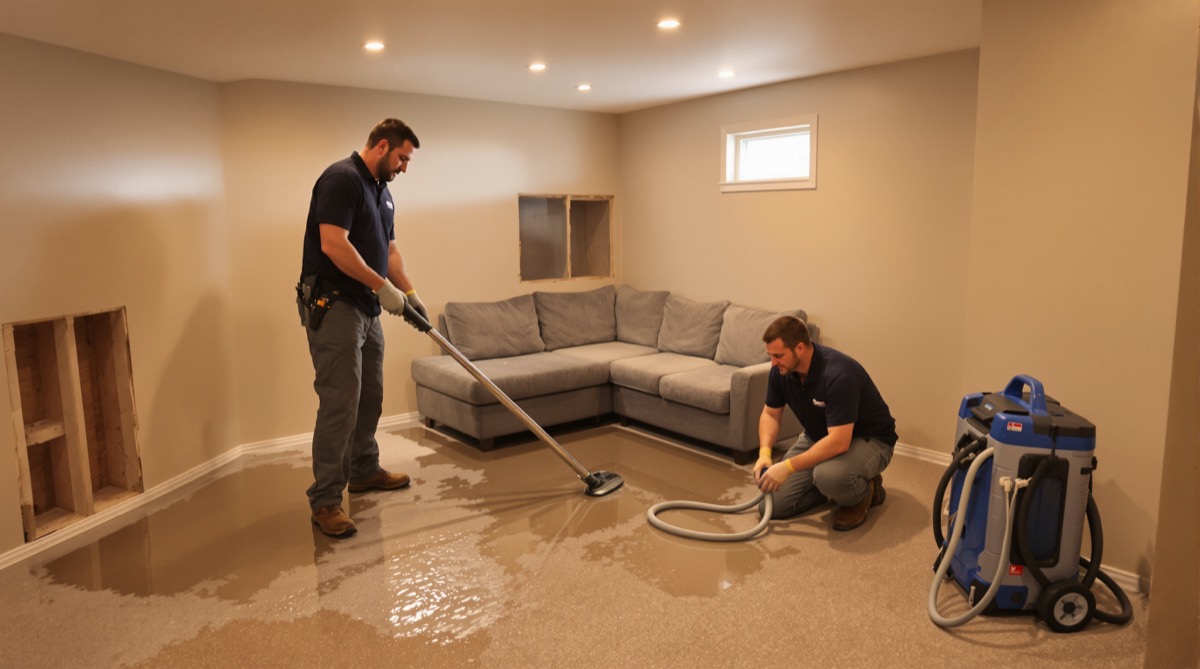
Concrete holds water and releases it slowly. A slab that soaked for a day can keep humidity high for a week. Commercial dehumidifiers matter more here than anywhere else in the house, and we track readings on the slab and walls until they hit a dry goal.
Crawlspaces are tight, dark and easy to ignore. Standing water or wet soil under a home raises humidity in the floors above and can lead to mold on joists. We pump, dry and document crawlspaces with the same care as finished rooms. Fairfield water damage restoration in a crawlspace takes patience, but skipping it usually means a musty house a few months later.
Storm and flood cleanup on low ground
When heavy rain sits over the Passaic River Valley, low areas collect it. Storm water that enters a building is not the same as a clean supply-line leak. It carries soil, debris and whatever it picked up along the way, so it is treated as contaminated water.
For flood cleanup, porous materials that the water touched usually have to go: carpet, pad, the bottom of drywall, insulation, and some furniture. Hard surfaces are cleaned and disinfected. Then drying starts. Our crew wears protective gear and keeps contaminated materials out of clean areas of the building.
Safety comes first during and after a flood. Do not walk through standing water if outlets or cords are submerged, and keep children and pets away. Ready.gov keeps practical flood safety guidance that is worth reading before the next big storm.
If a storm sends water into your home or business, call (973) 992-4400. The phone is staffed at all hours, and a crew heads out right after we talk. Learn more about our general water damage restoration services.
Burst pipes when the cold settles in
Groundwater gets most of the attention in a low township, but winter brings its own calls. Pipes in exterior walls, garages, crawlspaces and unheated additions can freeze during a hard cold snap. The break usually shows itself when the ice thaws and water under full pressure starts running.
A burst line can release a lot of water in a short time, and it often happens behind a wall or above a ceiling. By the time you notice, insulation and drywall may be soaked across more than one room. Shut the main, call us, and let your plumber repair the pipe while we take care of extraction and drying.
The same cold can freeze a sump discharge line, which turns a working pump into a recirculating one. If your pump runs and the pit never empties during a freeze, the outlet may be blocked with ice.
Businesses along Interstate 80 and Route 46
Interstate 80 and Route 46 both cut through Fairfield, and the township is home to a number of corporate residents and the Essex County Airport. Commercial buildings get wet for the same reasons homes do, plus a few of their own.
Common commercial sources include roof drains that back up in heavy rain, sprinkler lines that break or freeze, failed water heaters in break rooms, and flooding in low loading areas. Offices, warehouses and light industrial spaces each have their own priorities: protecting inventory, keeping records dry, and getting employees back to work.
Our commercial water damage team plans around your operations. We can isolate wet areas with plastic containment, work in phases, and keep unaffected parts of the building open where it is safe. Moisture mapping and daily logs give property managers and owners a clear picture of progress.
For commercial Fairfield water damage restoration, the same documentation we provide homeowners goes to the business owner, property manager or landlord, so everyone works from the same record.
Warehouses and light industrial buildings often have large open floors, high ceilings and concrete slabs. Drying a space like that calls for more dehumidification capacity than a house, careful airflow planning, and readings taken across the whole slab. Fairfield water damage restoration in a commercial building also means working around deliveries, staff and customers, which we plan with you before setting up.
What arrives on our trucks
The right tools make drying faster and more predictable. Depending on the job, our crew brings:
- Truck-mounted and portable extraction units for carpet, pad and hard floors.
- Submersible pumps for basements and lower levels with deep water.
- Air movers that push air across wet surfaces and into wall cavities.
- Commercial dehumidifiers that strip water vapor from the room.
- Pin and pinless moisture meters to measure wood, drywall and concrete.
- Thermal imaging cameras that help locate hidden moisture.
- HEPA air scrubbers, negative air machines and plastic containment for mold and contaminated water jobs.
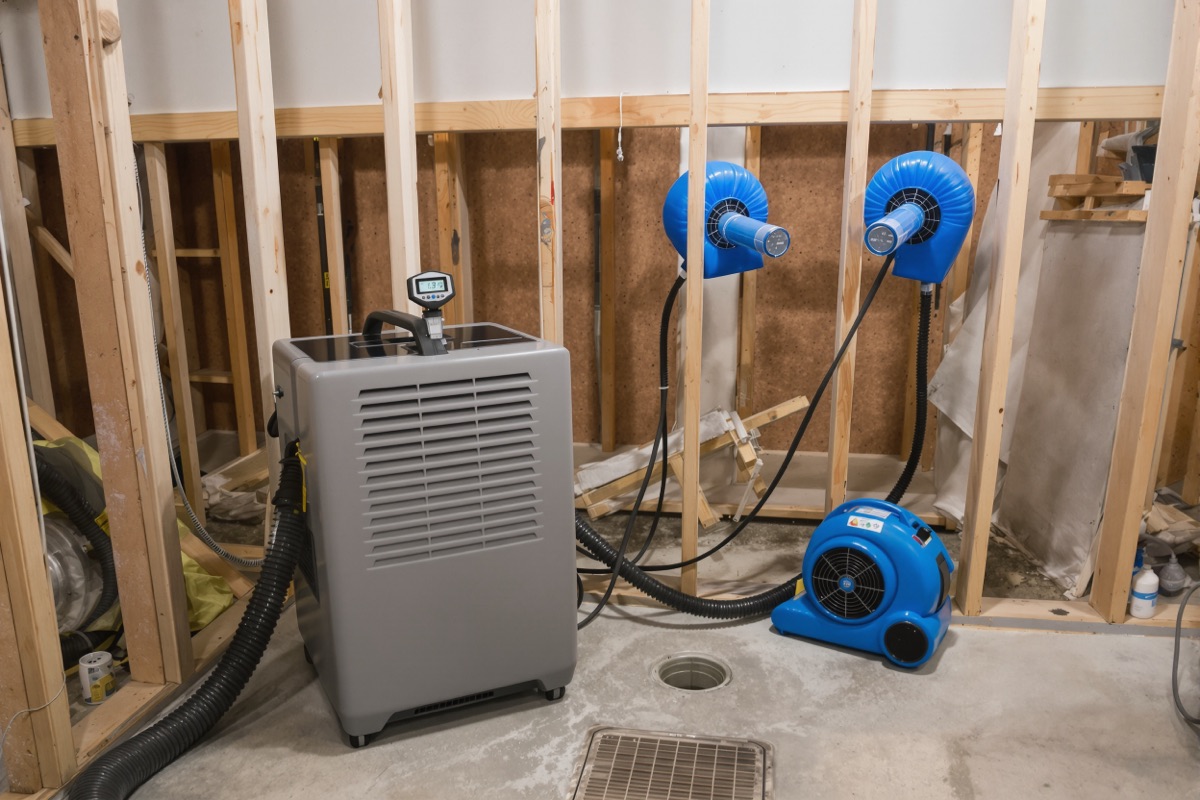
Equipment placement is part science, part experience. We set air movers so they create airflow along walls, run dehumidifiers sized for the space, and move equipment as rooms dry. Readings, not guesswork, decide when the machines come out.
Mold in damp, low-lying buildings
Constant moisture is mold’s best friend. Buildings near wet ground, with a high water table or a history of basement water, give mold the time it needs to grow on drywall paper, wood and carpet backing.
When growth is present, our mold remediation process isolates the area with plastic containment and negative air, filters the air with HEPA scrubbers, strips out growth-covered material, HEPA-vacuums and wipes what remains, and dries the space. The finished file includes images, infrared shots and meter numbers.
Mold comes back if the moisture does. That is why we pay as much attention to drying and to explaining where the water came from as we do to removal. Fixing a drainage issue or upgrading a sump pump may fall to another contractor, but we will tell you what we observed.
Very old buildings and newer additions
Fairfield has some very old structures. The Van Ness House was built around 1720, and the current Fairfield Dutch Reformed Church building dates to 1804. Buildings from that era often have stone foundations and solid wood framing that absorbs and releases water slowly.
Plenty of properties combine an older core with later additions. The joint between an old foundation and a newer one is a natural path for water. When we dry a building like that, we check both sides of the seam and take readings in places that are easy to miss.
Older wood and plaster deserve a careful hand. Instead of tearing out everything that got wet, we measure, dry in place where it makes sense, and remove material only when the readings or contamination require it. Old stone foundations can also hold moisture for a long time, so dehumidifiers stay on longer in those basements.
Rebuilding the space
When the structure tests dry, the rebuild begins: wallboard, insulation, floors, millwork, cabinets and paint, whatever had to come out. You do not have to find a separate contractor and explain the whole story again.

For a finished basement, that often means new drywall, insulation and flooring, and sometimes moisture-resistant materials where water is a recurring risk. Visit our remodeling page to see more about how we put rooms back together.
The record we leave behind
We photograph, measure and log every day of the job, and that file goes to you for the insurance adjuster.
Your insurer interprets the policy and makes the coverage decision. Our role is to make sure the facts are complete and easy to follow: where the water came from, what it touched, what had to be removed, and how the drying progressed day by day.
Fairfield water damage restoration across the county line
Fairfield borders towns in Essex, Morris and Passaic counties. Our crews work throughout the region, so the help is the same on either side of the line.
Nearby, we provide water damage restoration in West Caldwell, water damage restoration in Montville, and water damage restoration in Wayne. Our full service areas page lists every Essex, Morris, Passaic, Bergen and Hunterdon town on our map. You can also read more about DryMax.
Frequently asked questions about water damage in Fairfield
My Fairfield basement is damp even when it has not rained. Why?
Low ground near marshland often means a high water table. Groundwater can push up through the slab or in at the wall joint even in dry stretches. We can measure moisture in the floor and walls, dry what is wet, and show you where it is coming in.
Is storm water in my basement dangerous?
Storm and flood water is treated as contaminated. Keep children and pets out, avoid contact, and do not enter if outlets or cords are underwater. Our crew removes affected porous materials, cleans and disinfects hard surfaces, and dries the space.
Can you work in an office or warehouse without shutting everything down?
Often, yes. We contain wet areas, work in phases and keep unaffected areas usable where it is safe. Every step is documented for the owner or property manager.
Do you dry crawlspaces?
Yes. We pump out standing water, dry the soil and framing, and take readings until the space hits its dry goal. A wet crawlspace affects the humidity in the whole building above it.
Will insurance pay for this?
Your insurer decides based on the policy wording. We give you the pictures, moisture numbers and drying notes the adjuster will want to see.
Can you rebuild the basement after drying?
Yes. Walls, floors, cabinets, trim and paint are all handled by our own rebuild crew.
Ready when you call
Low ground does not give water many places to go. If it has found its way into your Fairfield home or business, ring DryMax at (973) 992-4400. We answer every call 24/7/365, nights and holidays included, and get a crew rolling right away.