
Long before it became a quiet suburb in western Essex County, much of the land that is now West Caldwell was farmland and swamp. Wet ground has a long memory. Homes built on it can stay dry for years and then take on water the first time a storm stalls overhead or a sump pump gives out. DryMax provides West Caldwell water damage restoration at any hour, and we understand why basements here behave the way they do.
Our IICRC certified team has been locally owned since 2018. We answer the phone ourselves, day or night, weekends and holidays included, and we get a crew moving the moment you hang up.
A township built on farms and swampland
West Caldwell began as part of the old Horseneck Tract and later Caldwell Township. In the late 1880s, the outskirts of the original town were still farms and swampland in many places. After Caldwell split off its center, the western part stayed less developed for a while, with several farms and a large area of undeveloped swampland. The settlements of Franklin and Westville grew there, and in 1904 they joined to form the borough that became today’s township.
Why does a hundred-year-old land history matter when your basement floods tonight? Because soil that was once wet tends to stay closer to saturation. A high water table pushes up from below, and when rain arrives faster than the ground can absorb it, that water looks for the easiest way out. Too often, the easiest way is through a basement floor crack, a cold joint where the wall meets the slab, or a gap around a pipe.
We see this most during long, soaking rains and in spring when the ground is thawing. The water comes in slowly, often without any visible leak, and the first sign is a damp carpet edge or a musty smell from behind the finished walls.
Living near Hatfield Swamp
Hatfield Swamp sits in the western section of town along the borders with Fairfield, Roseland and East Hanover. It is a protected preserve where very little building is allowed. That protection is good for wildlife and for flood storage, but homes on the streets nearest the swamp still sit beside some of the wettest ground in the area.
If your house is near the western edge of town, a few things are worth checking now, before the next storm:
- Do your downspouts carry water at least several feet from the foundation?
- Does the yard slope away from the house on every side?
- Is there a working backup for the sump pump, and has anyone tested the float this year?
- Are storage boxes in the basement on shelves instead of the floor?
None of those steps stop groundwater completely, but they buy time. And when water does get in, time is what limits the damage. Drywall that sits in water for an hour usually dries. Drywall that sits overnight often needs to be cut.
Homes near the Roseland line share much of the same ground. Neighbors there can read about our water damage restoration in Roseland, and those closer to the swamp on the other side can see our page on Fairfield water damage cleanup.

Franklin, Westville, Ferncliff and Pine Brook Bridge
Ferncliff, Franklin, Pine Brook Bridge and Westville are all place names within the township. Each grew at its own pace, so the homes vary. Many older houses in town sit on block or stone foundations from before modern waterproofing. Later houses often have poured walls and sump pits but also finished basements that hold far more value than a storage cellar ever did.
Older houses near the original settlements
Older foundations were rarely meant to be watertight. A cellar of that era was usually built for storage, and a little dampness was simply expected. Once someone frames walls, lays carpet and adds a home office, the same dampness becomes a problem. Moisture behind drywall can wick upward for weeks without showing on the surface.
Split-levels and finished lower floors
If your house has a lower level half below grade, there is a shorter distance between the outside soil and the living space. A clogged window well or a downspout that empties at the corner of the house can send water straight into a family room. In these homes we pay close attention to the wall cavities on the uphill side and to the subfloor beneath carpet or laminate.
Upstairs leaks in any house
Not every call comes from the basement. Supply lines under sinks, refrigerator ice-maker lines, washing machine hoses and water heaters can fail on any floor. A leak that starts upstairs spreads into ceilings, insulation and wall cavities, and it often looks smaller than it really is.
Sump pumps carry the load
In a town with this much history of wet ground, the sump pump is the most important appliance in many basements. It runs quietly for months and then works hard for two days straight during a storm. If it fails at the wrong moment, the basement fills.
Common reasons we find a pump has failed:
- A power outage during the same storm that raised the water table
- A float switch that stuck against the side of the pit
- A motor that simply wore out after years of cycling
- A discharge line frozen or clogged outside the house
- A pump too small for the volume of water coming in
When we arrive at a flooded basement with a dead pump, we set our own submersible pumps first so the water stops rising. Then we extract, map the moisture and start drying. We are not plumbers, so we will tell you when the pump itself needs replacing by a licensed professional, but we will keep the space dry while you arrange that.
Cold snaps and burst pipes
Groundwater is the spring and summer story. Winter brings a different call. When temperatures drop hard for several nights in a row, pipes in exterior walls, unheated garages, crawlspaces and attic runs can freeze. Ice expands, the pipe splits, and nothing happens until it thaws. Then water pours out at full line pressure, sometimes for hours if nobody is home.
A burst pipe on an upper floor is one of the most destructive leaks we handle, because water moves down through every layer: flooring, subfloor, ceiling below, insulation, and then the next floor. By the time it reaches the basement, three rooms may be wet.
If a pipe bursts, shut the main water valve first. Most homes have it in the basement near where the line enters the house. Turn off power to any area where water is reaching outlets or fixtures, if you can do so safely. Then call us. Our West Caldwell water damage restoration crew will extract the water, open only what the moisture map shows is wet, and dry each floor in turn.
Some simple habits reduce the risk. Keep the heat on when you travel, even if it is set low. Open cabinet doors under sinks on outside walls during deep cold. Disconnect garden hoses before the first freeze. And know where your main shutoff is before you ever need it.
Parks, trees and wooded edges
Grover Cleveland Park, a county park, lies partly in West Caldwell, and the township also has smaller parks and preserves such as Memorial Park and Francisco Park. Streets near parkland and big trees are pleasant places to live, and they also bring a steady load of leaves into gutters every fall.
Clogged gutters overflow right at the foundation, which is the last place you want extra water on ground that already runs wet. Overflow can also back up under the roof edge and find its way into a soffit or the top of an exterior wall. When we trace a ceiling stain near an outside corner, a blocked gutter above it is one of the first things we look for.
West Caldwell water damage restoration, step by step
Each job is a little different, yet the order of work stays steady. Here is how a typical visit unfolds.
1. Make it safe and find the source
We check for electrical risks in wet areas and figure out what kind of water we are dealing with. Clean water from a supply line is handled differently from groundwater, and both are handled differently from a sewer backup. If a pipe is still leaking, we help you shut it off.
2. Remove the water
Truck-mounted and portable extractors pull water out of carpet, pad and hard floors. Pulling liquid out is much faster than drying it, so this step gets real attention. In a deep flood, submersible pumps go in first.
3. Map where it went
Pin and pinless moisture meters read the drywall, framing, subfloor and trim. A thermal imaging camera shows cool, damp patterns behind walls and under floors. We mark the edges of the wet area and photograph each reading.
4. Remove what cannot be saved
Soaked carpet pad, wet insulation and drywall that has wicked water too high usually need to come out. We cut drywall in a straight line just above the wet mark, which keeps the rebuild simple.
5. Dry the structure
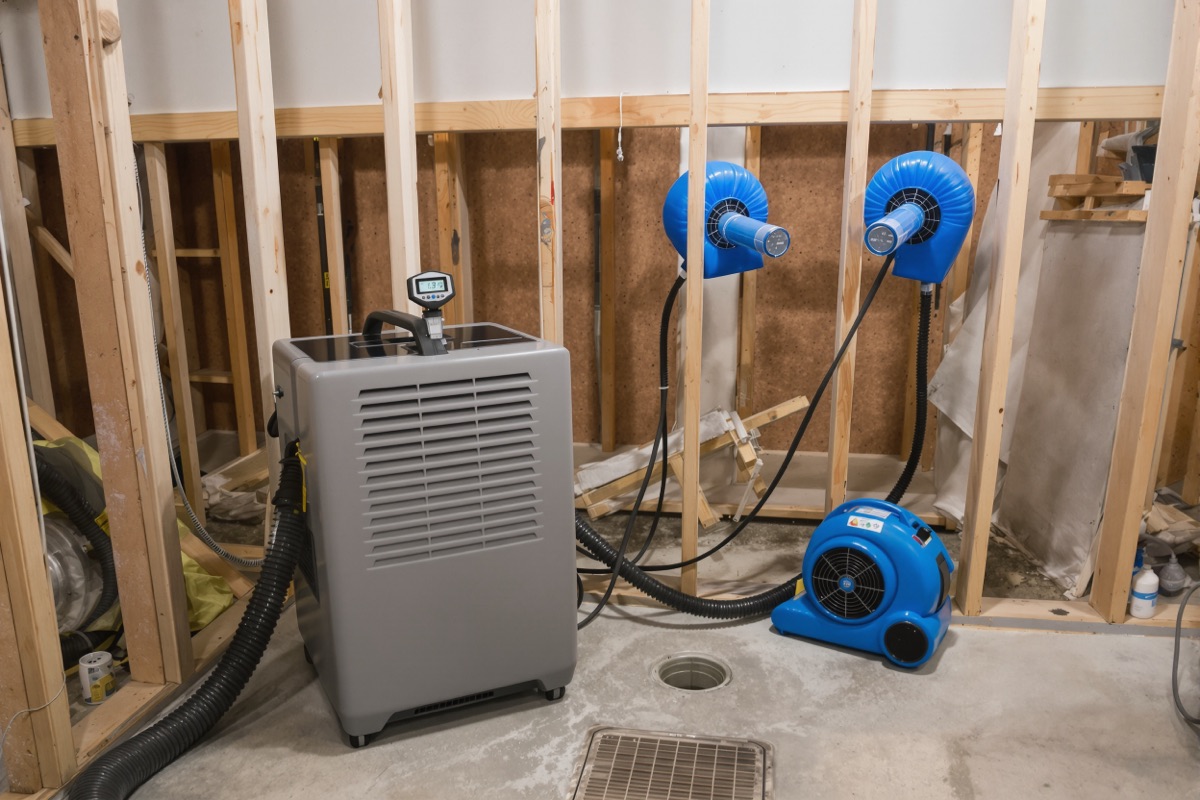
Air movers push air across wet surfaces. Commercial dehumidifiers pull the moisture out of that air. We return to check readings and adjust equipment until every material is back to normal.
6. Rebuild
Our crew puts the space back: new drywall, insulation, flooring, paint, trim and cabinets. You deal with one company the whole way through. More detail on each phase lives on our water damage restoration page, and our rebuild and remodeling page shows what the finish work looks like.

Stores and offices on Bloomfield Avenue
Bloomfield Avenue runs through the center of town and is home to many locally owned stores. The township also has several stores and strip malls. A water problem in a store is about more than drywall. Every day closed costs sales, and customers notice wet ceilings and the smell of a damp floor.
For businesses, we plan the drying around your hours when we can, contain the work area so you can keep part of the space open, and keep a written log for your landlord and adjuster. In a strip of connected storefronts, one leak can cross into the unit next door, so we check shared walls as a matter of routine. Our commercial water damage page explains how we handle offices, retail spaces and multi-tenant buildings.
When a damp basement turns to mold
A basement that floods once and dries fast seldom grows mold. One that stays damp for weeks can. On wet ground, a slow seep behind a finished wall is exactly the kind of moisture that feeds growth without anyone noticing until the smell gets strong.
Our remediation follows a clear sequence. Plastic sheeting isolates the area. A negative air machine pulls air out through HEPA filtration, which keeps spores from drifting into the rest of the house. Affected porous material comes out, solid surfaces are HEPA-vacuumed and cleaned, and the area is dried. We show the result with moisture readings, photos and thermal images. See our mold remediation page for more about how that work is done.
Choosing a West Caldwell water damage restoration crew
When the basement is full of water, it is hard to think about anything except getting it out. Still, a few questions help you pick the right help:
- Is the crew IICRC certified?
- Will they take moisture readings and keep a drying log?
- Do they do the rebuild themselves, or hand you off to someone else?
- Will someone answer the phone at two in the morning?
We can say yes to all four, and that is the standard we hold for West Caldwell water damage restoration. That is what we would want if it were our own house, and it is how we run every job, whether it is a single wet room or an entire lower level.
On insurance, we stay in our lane. Coverage depends on your policy and on the cause of the water, and that decision belongs to the adjuster. What we provide is the evidence: photos, readings and drying logs that show what happened and what was done. Homeowners who get started with West Caldwell water damage restoration right away usually have the cleanest record to hand over.
The federal Ready.gov flood guidance is also worth a look before storm season. It covers what to do before, during and after a flood, including staying out of water that may be electrically charged.
Frequently asked questions from West Caldwell homeowners
Why does my basement take on water even when it has not rained much?
On ground that was once farmland and swamp, the water table can stay high for long stretches. Groundwater pushes up through floor cracks and wall joints even after modest rain, especially in spring when the soil is thawing and already full.
I live near Hatfield Swamp. Is my home more at risk?
Homes near the wettest ground in town tend to see more groundwater pressure. That does not mean your basement will flood, but a reliable sump pump with a backup, good gutters and grading that slopes away from the house matter more there.
My sump pump died and the basement is filling. What now?
Stay out of the water if it is near outlets or appliances. Check whether the breaker tripped. Then call us. We bring pumps to stop the water from rising and start extraction right away.
Can you save my finished basement carpet?
Sometimes. If the water was clean and we reach it quickly, carpet can often be extracted and dried in place. The pad underneath usually needs to be replaced. Water from outside or from a sewer line means the carpet has to go.
Do you work on stores and offices in town?
Yes. We handle retail spaces, offices and multi-tenant buildings, with containment and scheduling that help you keep the doors open when possible.
Which nearby towns do you cover?
All of West Essex and well beyond. Residents next door can read about water damage restoration in Caldwell, and our full service area list shows every town we cover.
Pick up the phone
If water is coming in right now, call (973) 992-4400. A person answers every call, at every hour. Tell us what you see, and we will help you protect what you can until the crew arrives. You can learn more about DryMax anytime.