
Montville water damage restoration covers a lot of ground, because this is a big township with several distinct parts. Its sections are Montville, Pine Brook and Towaco, and other places inside the township carry their own names too, including Lake Valhalla, Lower Montville, Taylortown, Horse Neck Bridge and White Hall. The water risks in a lakeside home, a house on old farmland in the south end and a property on a wooded slope are not the same, so we do not treat them the same.
DryMax Water Restoration is locally owned and has served Essex, Morris, Bergen, Passaic and Hunterdon counties since 2018. Our crews hold IICRC certification. When you call (973) 992-4400, someone answers, at any hour, on any day of the year, including weekends and holidays. Here is a section-by-section look at what we watch for in this township and how we respond when water gets in.
Nineteen square miles, three villages
The township covers about 19.12 square miles, including roughly half a square mile of water. It was incorporated in 1867 from part of Pequannock Township. Before that, it grew as a set of separate villages: the original Montville settlement along the early road that is now U.S. Route 202, a canal village at Towaco and a farming area at Pine Brook.
A township this size has a wide spread of terrain. Some accounts even trace the name to the township’s place in the mountains of northern New Jersey. Hilly ground sends runoff downhill toward foundations. Low ground near streams and old fields holds groundwater. Lakes raise the water table for nearby homes.
Long before any of these villages, Dutch farmers who arrived in 1710 called the area “Uyle-Kill,” a name for the creek and valley running through it. A township named for a creek and valley has always been shaped by moving water, and many homes today sit somewhere along that drainage. Knowing where your house sits in that landscape is the first step in understanding why water shows up where it does, and it shapes how we plan Montville water damage restoration from the first visit.

Towaco and the old canal corridor
The Morris Canal was completed through this area in 1828, bringing commercial boats to the Montville and Towaco area, and that Towaco grew in the mid-1800s as a village situated on the canal. Today, Towaco station serves NJ Transit’s Montclair-Boonton Line.
A canal follows low, level ground, because water has to stay put in it. Homes that went up along that old corridor may sit lower than the land around them. When long rains saturate the soil, low ground is where groundwater comes up first. Basements in those spots can see seepage at the floor joint, water around a floor drain or a sump that cycles constantly.
Towaco also has a mix of older village houses and newer construction. Older homes may have fieldstone or block foundations, which let water through mortar joints more easily than poured walls. If your basement smells damp every spring, or you see a white, chalky line along the bottom of the walls, that is moisture moving through the masonry. A dehumidifier helps day to day. A real water event, like a failed sump during a storm, needs extraction and structural drying.
Pine Brook and the low farm ground of the south end
Pine Brook grew up as a fertile agricultural area in the township’s southern end. Fertile farm ground is often low, flat and well watered, and that is good for crops but not always for basements. Soils that hold moisture for growing also hold it against foundation walls.
The south end is also where the big highways run. Interstate 80 and U.S. Route 46 cross the southern part of the township, while Interstate 287 and Route 202 run through the north. Large paved surfaces shed rain quickly, and that water has to go somewhere. In heavy storms, the drainage systems that carry it can back up into low yards and streets.
For homes in this part of town, the most common problems we would expect are rising groundwater, sump pump failures and sewer or storm drain backups during heavy rain. Each needs a slightly different response. Clean groundwater can often be extracted and dried. Water that backed up through a floor drain is contaminated and calls for removal of porous materials, cleaning and sanitizing before drying begins.
If you want to see how flood risk is mapped near your property, FEMA’s flood map service lets you search by address. It will not tell you about pipe leaks or sump failures, but it is a good place to start for surface flooding.
Older houses along the original road
The first road through the settlement was started in the 1740s, and it is now U.S. Route 202. It linked farms with the township’s first gristmill, sawmill and tanneries. By 1820 there were 16 houses in the village, and by 1880 there were about 40. Washington’s troops used a route through the area during the Revolution, and he stayed in the Towaco section in June 1780.
With a history that long, some properties in the township carry real age. Older houses can have stone foundations, timber framing, plaster walls and wide plank floors, along with additions from many later decades. Water behaves differently in each of those materials. Stone walls pass moisture slowly but steadily. Old timbers soak up water and take a long time to give it back. Plaster can feel dry on the surface while the lath behind it is still wet.
For historic and older homes, Montville water damage restoration means slower, more careful drying. We take readings against dry materials in the same house, avoid tearing out original finishes when they can be saved and use moisture meters rather than touch to decide when a wall or floor is truly done.
Lake Valhalla and homes near the water
Lake Valhalla is one of the named places inside the township. Homes near any lake live with a few extra water concerns. The water table around a lake tends to sit higher than it does on a ridge, so basements and crawl spaces close to the shoreline can stay damp and take on water quickly after a big rain.
Lake homes are also often built into a slope that runs down toward the water. That can mean a walkout lower level with doors and windows at grade. A heavy storm can push water against those openings, and a clogged drain at the bottom of an exterior stairwell can flood a finished room in minutes.
Crawl spaces deserve special attention near a lake. They are dark, rarely visited and full of wood framing. A small leak or chronic dampness down there can lead to soaked insulation, rotting sill plates and mold on the underside of the floor. We inspect crawl spaces with moisture meters and a thermal camera, remove wet insulation and dry the framing with air movers and dehumidifiers.
From minus 25 to 105: Montville water damage restoration through the seasons
The township’s record low is minus 25 degrees Fahrenheit, set in February 1943, and its record high as 105 degrees, reached in July 1936 and again in 2011. Those are extremes, but they show how wide the swing can be. Both ends cause water damage.
Winter is about frozen pipes and ice. Pipes in an exterior wall, an unheated garage, a crawl space or a seasonal room can freeze on a hard night. The leak usually starts when the pipe thaws, and the water keeps running until someone shuts the main valve. Ice dams at the roof edge can send meltwater into attic insulation and down the inside of walls.
Summer is about humidity and the cooling system. Central air conditioners make a lot of condensation, and that water drains through a pan and a small line. If the line clogs or the pan rusts through, water drips into a ceiling, a closet or a finished basement for days before anyone notices. Summer thunderstorms also bring sudden heavy rain that overwhelms gutters and sump pumps.
Good Montville water damage restoration is ready for both seasons. In winter, we often dry homes while the heat is running, which changes how we set the dehumidifiers. In summer, we keep humidity under control so drying does not stall in muggy air.
Attics, condensation and summer mold
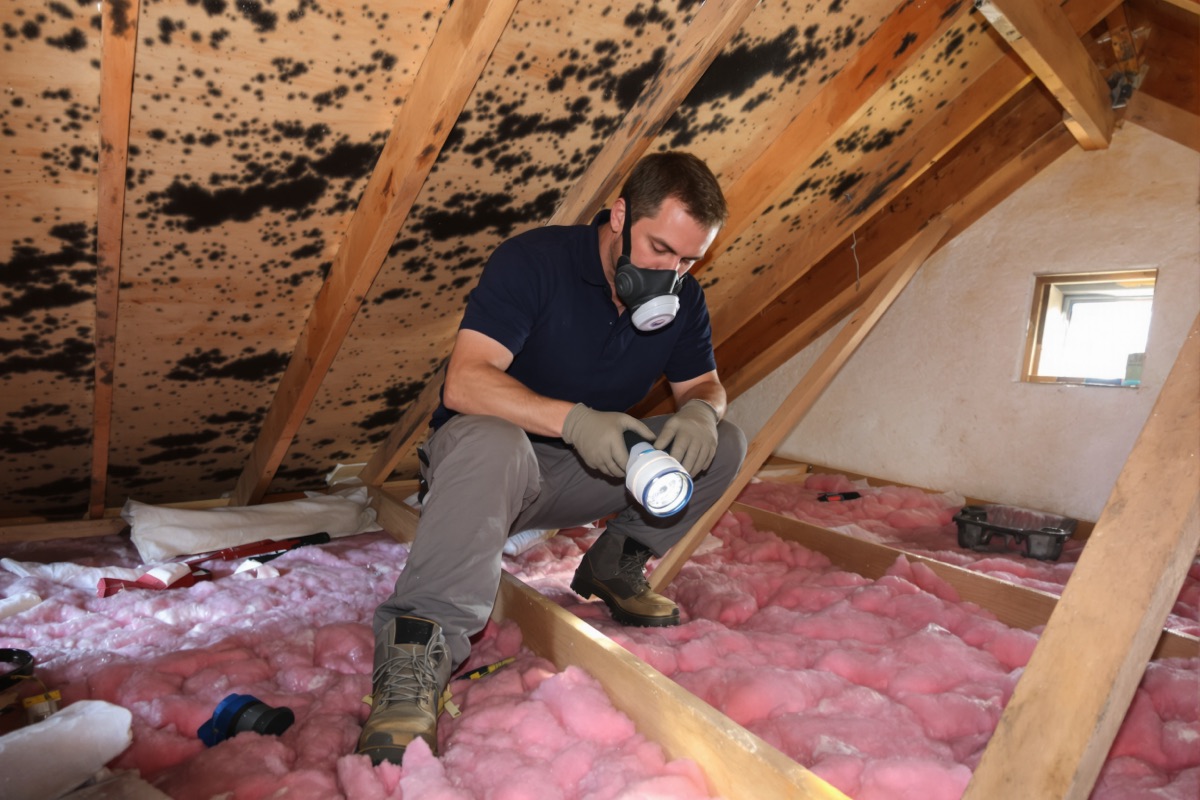
Attics take a beating in a climate with hard winters and hot, humid summers. In winter, warm moist air from the house can rise into a cold attic and condense on the underside of the roof sheathing. In summer, an air handler or ductwork in the attic can drip condensation onto insulation and ceilings. Over time, either pattern can lead to dark staining and mold on the wood.
The EPA’s guidance on mold is simple: control the moisture and mold growth slows or stops. When mold has already taken hold, our mold remediation process uses plastic containment and negative air machines to keep spores from spreading, HEPA air scrubbers to clean the air, removal of materials that cannot be cleaned, HEPA vacuuming and cleaning of what remains and drying of the area. We show the result with moisture readings, photos and thermal images.
We do not do roofing or ventilation repair, so if the cause is a roof or vent problem, we will point it out and you can bring in the right trade.
Water heaters, washers and the leaks inside
Storms get the headlines, but plenty of calls start with an appliance. Water heaters in basements and utility rooms eventually corrode, and when the tank fails, it can dump its whole load onto the floor and keep refilling. Washing machine hoses crack with age. A dishwasher or refrigerator line can leak slowly under a kitchen floor for weeks.
Bigger homes add more of these risks. A second-floor laundry, a primary bath with a large tub and a wet bar in the basement are each one more place for water to escape. When an upstairs fixture leaks, the damage spreads down through ceilings, walls and floors on every level below it.
Inside leaks call for a careful trace. In Montville water damage restoration, we follow the water from the source outward with thermal imaging and meters, so the drying covers every wet spot and nothing gets closed up damp.
What happens when our crew shows up
Every job begins the same way, even though every house is different. After a short call to understand the situation, we send a crew as soon as you call. On arrival, we look for hazards, photograph the affected areas and take baseline moisture readings in wet and dry parts of the house.
Water removal comes next. For a flooded basement, a submersible pump moves the deep water out fast. Truck-mounted and portable extractors pull water from carpet, pad and hard floors. Getting as much water out as possible at this stage cuts down the drying time later.
Then we map the moisture. A thermal imaging camera shows cooler, damp areas behind walls and ceilings, and pin and pinless meters confirm the readings. We remove materials that will not dry or are contaminated and set air movers and commercial dehumidifiers where the map says they need to be.
Every day after that, a technician returns, checks readings and moves equipment as areas dry. We pull the equipment only when the materials reach normal levels, and you get all the photos, readings and drying logs to give your adjuster. Coverage depends on your policy, and your insurer makes that decision. Our job is to make sure the record is complete. Read more on our water damage restoration page.
Montville water damage restoration through the rebuild
When the drying is done, the house usually still has open walls, missing baseboards and maybe a bare floor. We do not hand you off to someone else at that point. Our remodeling crews replace drywall and insulation, tape and paint, lay new flooring and reinstall trim and cabinets. One company runs the job from the first call to the finished room.
That matters most in finished basements, which are common in suburban homes across Morris County. A lower level with a family room, guest bedroom or home office can lose carpet, drywall, trim and built-ins in a single sump failure. Rebuilding it right means matching what was there, and the photos we took on day one help with that.
For businesses in the township, including shops and offices along the main roads, our commercial water damage service handles larger spaces with the same documentation. From a small home office to a full commercial suite, Montville water damage restoration ends when the space is back in use.

Frequently asked questions from Montville residents
Do you work in Towaco, Pine Brook and Lake Valhalla?
Yes. We serve the whole township, including Towaco, Pine Brook, Lake Valhalla, Lower Montville and the other sections. Call (973) 992-4400 from anywhere in town.
My crawl space near the lake is always damp. Is that a water damage problem?
It can be. Chronic dampness can soak insulation and lead to mold on the floor framing. We check crawl spaces with moisture meters and thermal imaging and dry them out when the readings call for it.
Our AC drain line overflowed into the ceiling. Can you dry it?
Yes. We find how far the water spread, open only what has to come out and dry the ceiling and framing with air movers and dehumidifiers, checking readings daily.
Water came up through the floor drain during a storm. Is it safe to clean myself?
Water from a floor drain may be contaminated with sewage. It is safer to stay out of it. We remove porous materials it touched, clean and sanitize hard surfaces and then dry the space.
Do you repair the pipe that burst?
No. A licensed plumber repairs the pipe. We handle the water removal, drying, any mold work and the rebuild afterward.
Can you help my insurance claim?
We document every job with photos, moisture readings and drying logs that you can give your adjuster. Coverage depends on your policy, and your insurer decides.
Talk to a person now
If you have water in your house or business anywhere in the township, call (973) 992-4400. A real person answers every hour of every day. We also serve your neighbors, with water damage restoration in Mountain Lakes, Kinnelon water damage cleanup and Fairfield water damage help. Our service areas page lists every town, and you can read more about DryMax.