
Lakes, ponds, wooded slopes and mountain views give Kinnelon its character, and they also shape the way water gets into homes here. This guide walks through Kinnelon water damage restoration with the borough’s own landscape in mind, from lakeside cottages to hillside houses, and explains how we extract, dry, treat and rebuild. Locally owned since 2018 and staffed by IICRC certified technicians, DryMax keeps (973) 992-4400 staffed through every night, weekend and holiday.
If water is spreading right now
Close the valve that feeds the leak if you can find it. For a burst line or a failed water heater, the main shutoff is usually where the water service enters the house, often in the lower level or a utility room.
Keep clear of standing water near outlets, cords or appliances. Shut off power to the affected rooms only if the panel is in a dry spot. Lift rugs, electronics and keepsakes off the floor, and photograph the rooms and the source before much gets moved.
Then pick up the phone and dial (973) 992-4400. You get a human on the line, and our technicians start packing the truck while you are still talking. Kinnelon water damage restoration goes faster and saves more of the original materials when extraction starts early, so waiting to see whether it dries on its own rarely pays off.
Kinnelon water damage restoration in lake country
Kinnelon covers about 19 square miles in Morris County, and more than 6 percent of it is lakes, ponds and other water, a large share for a North Jersey borough. Lake Kinnelon is the largest lake, and the list of named water bodies runs long: the lakes at Fayson Lakes, Ideal Lake, Saw Mill Pond, Stickle Pond, Sun Tan Lake, Surprise Lake and Untermeyer Lake among them.
Living near water brings a few predictable challenges. Groundwater tends to sit closer to the surface near lakes and ponds, and lower floors built into slopes that face the water can take on moisture through the foundation. Air near water is often more humid, which slows natural drying after any leak.
Parts of the borough are also owned by the City of Newark as part of its Pequannock River Watershed, and Splitrock Reservoir sits on the border with Rockaway Township. Much of the surrounding land is open, wooded and designed to collect water. Homes nestled into that landscape share its drainage.
To check whether your property falls in or near a mapped flood area, use the FEMA flood map service. Lake-adjacent homes can still have groundwater and runoff problems outside those zones.
Three sections, three kinds of risk
Kinnelon is made up of three primary sections: Kinnelon proper, Fayson Lakes and Smoke Rise. Each grew in a different era and on different ground, so the leaks we look for differ a little from one to the next.
The borough itself is young as a municipality but old as a place. It was once known as Charlotteburg, with iron forges and furnaces dating to the late 1600s, and it took its present name in 1922 from the Kinney family estate. Some properties carry that long story in their stonework and foundations, and older foundations deserve extra care when they get wet.
Fayson Lakes and Smoke Rise together accounted for roughly 42 percent of the borough’s households as of a 2005 estimate. Kinnelon also had the highest home ownership rate in the state in 2000. Put simply, most people here own the house they live in and care for it over many years, which makes careful, thorough Kinnelon water damage restoration worth the extra effort.
Fayson Lakes: summer cottages turned year-round homes
Fayson Lakes began in 1925 as a summer lake community built around a small pond that became West Lake. East Lake joined in 1931, and South Lake was created by damming in the 1950s. Most homes there stayed summer residences until the Second World War, and Fayson Lakes is still the borough’s most densely built area.
Houses that started as seasonal cottages and later became year-round homes often carry traces of that history. Original plumbing may have been designed for warm months, then extended, rerouted or insulated later. Additions and enclosed porches can sit on different foundations from the original structure. Any of that can create cold spots where pipes freeze, or seams where water gets in.
Because Fayson Lakes is the most densely built part of the borough, houses there sit closer together, and lots near the shoreline can collect runoff from higher ground during long rains. Older lake houses may have crawlspaces or partial basements, and those spaces need the same drying attention as a finished room.
When we work in a home like this, we look for the joints between old and new: where an addition meets the original wall, where a porch was closed in, and where newer plumbing ties into old lines. Those spots tend to tell the story. Kinnelon water damage restoration in a converted cottage often comes down to finding that one seam and drying both sides of it thoroughly, then pointing out the spot so it can be watched after future storms.
Smoke Rise: mountain lots and evening mist
Smoke Rise is a private gated community of more than 900 homes on about 3,500 acres, including Lake Kinnelon and Kitty Ann Mountain, which rises to 1,140 feet. The name translates a Native American name for the area, where a heavy mist often rises at sunset.
That mist is a good reminder of how much moisture moves through the air here. On humid evenings and damp mornings, surfaces stay wet longer, and a minor drip behind a wall dries more slowly. Basements and lower levels on wooded mountain lots can hold humidity for weeks after a water event if it is not properly dried.
Smoke Rise was planned after the Second World War as a community of architect-designed houses, with the land kept in its natural state as far as possible. Many homes set into slopes, among trees and rock, have walkout lower levels with one wall below grade on the uphill side. That wall takes the water pressure when the hill is saturated.
Wooded lots across the borough
Kinnelon is a low-density, suburban borough with many parks and trails. Silas Condict County Park covers about 1,000 acres, and part of the Pyramid Mountain Natural Historical Area lies within the borough. Trees and rock are everywhere.
Wooded lots bring their own water patterns. Leaves and needles fill gutters quickly, and a clogged gutter sends roof water over the edge right next to the foundation. Shade keeps soil and siding damp longer. Rocky ground can channel water toward a house instead of letting it soak in.
Most of the time, these factors combine with something else: a long rain, a sump pump that cannot keep up, or a downspout pointed the wrong way. When we arrive, we note what we see outside as well as inside, so you know where the water likely came from. Fixing gutters, grading or roofing falls to other trades, yet knowing the cause makes the next storm easier to handle.
Sump pumps on wet ground
Homes near lakes, ponds and wooded slopes often depend on a sump pump to keep groundwater out of the lower level. In a long rain or a fast snowmelt, that pump may run for hours at a stretch.
Pumps fail for ordinary reasons: a power outage during the storm, a stuck float, a worn motor, or a discharge line that freezes or clogs. When that happens on saturated ground, water can rise in a finished basement quickly. Carpet, padding, insulation and the lower edge of every wall start wicking it up.
For Kinnelon water damage restoration after a sump failure, the pit area and floor get pumped and extracted first, soaked wallboard is cut back as far as the meters show, and dehumidifiers and fans go in. Repairs to the pump itself are for your plumber, but we can tell you what we saw when we arrived.
Frozen pipes in cold, shaded houses
Shaded lots and higher elevations can mean colder walls and colder crawlspaces in deep winter. Pipes running through exterior walls, garages, crawlspaces and enclosed porches are the most likely to freeze.
The damage shows up during the thaw. A split pipe can pour water into a wall cavity or ceiling for hours before anyone notices, especially in a part of the house that gets little use in winter. Kinnelon water damage restoration after a freeze often involves more than one floor, because water travels down through framing and insulation.
Attics, roof edges and moisture you cannot see
Winters in the hills can be hard on roofs. Snow that melts during the day and refreezes at night can form ice dams at the eaves, pushing water under shingles and into the attic. Shaded roofs on wooded lots hold snow longer, which gives ice dams more time to form.
The first sign is often a stain on a top-floor ceiling or damp insulation in the attic. By then, roof sheathing may have stayed wet long enough to grow mold. Attics are easy to ignore, so these problems can go on for a while.
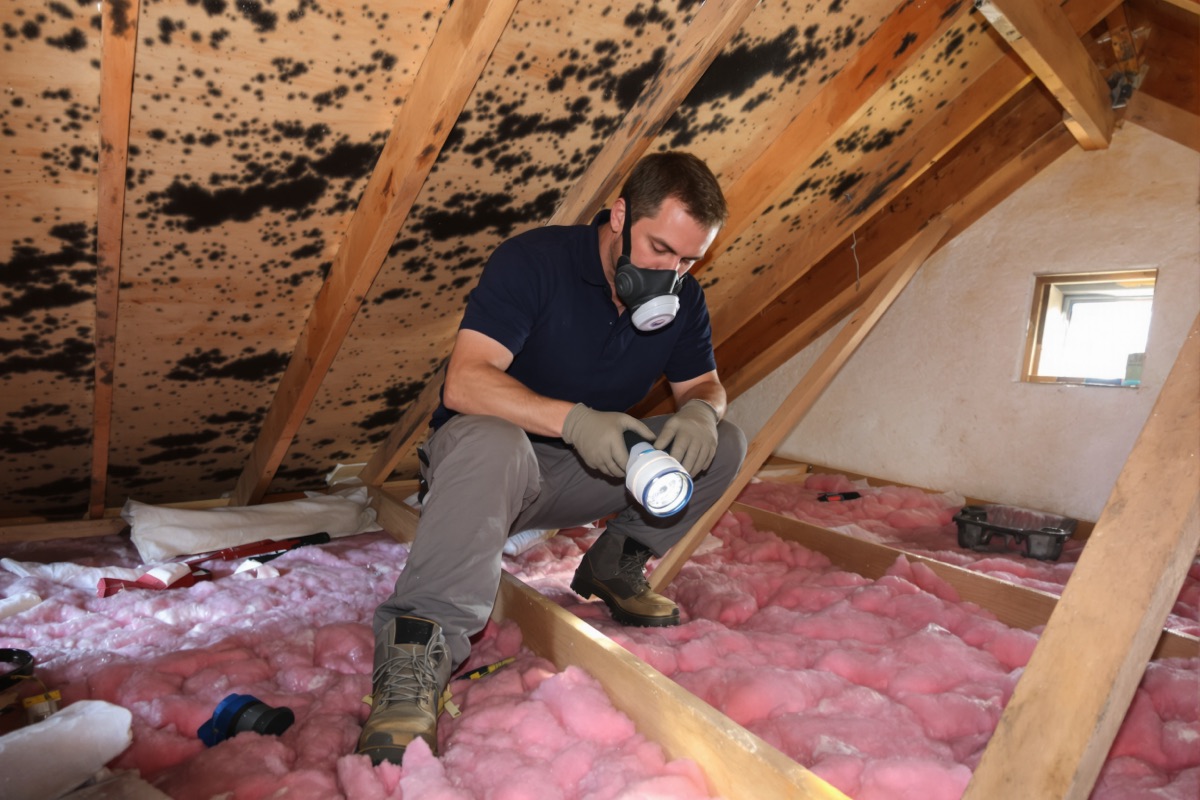
We dry wet attic framing and insulation, document the moisture with readings and thermal images, and handle mold if it has started. Roof repair itself belongs to a roofer, and we recommend having that done before the next storm.
How drying works on a lake or hillside property
The process stays consistent no matter where the home sits. What changes is how long it takes and how much equipment the space needs.
Extraction
Standing water comes out first. Truck-mounted or portable extractors work the carpet and floors, and submersible pumps handle anything deep. Fast, thorough extraction shortens every other step.
Moisture mapping
An infrared scan shows likely wet zones, and handheld meters, pin-type and pinless, confirm the boundary so we can flag it with tape. We photograph everything so you and your adjuster can see the starting point.
Selective removal
Soaked carpet pad, wet insulation and any wallboard beyond saving are taken out. Everything else stays and dries where it is.
Drying and monitoring
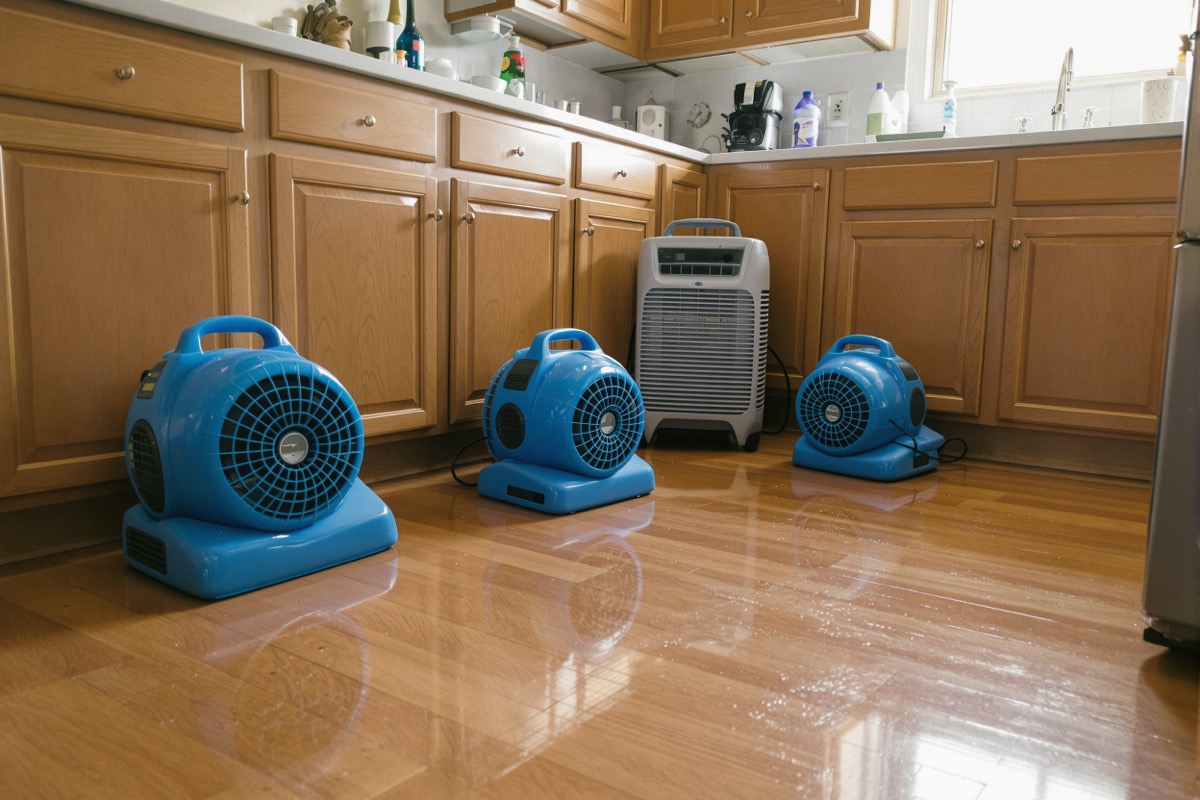
Fans and commercial dehumidifiers stay on until wood, drywall and concrete read dry. In humid lakeside or wooded settings, dehumidification does most of the work, and drying may take a little longer. We check readings daily and adjust as we go.
For a deeper look at each stage, visit the water damage restoration section of our site.
Humidity, shade and mold
Mold needs moisture and time. Humid air near lakes, shaded wooded lots and lower levels built into slopes all give it extra of both. That is why fast drying matters so much here.
If growth has already started, our mold remediation team walls off the room with sheeting, holds it under negative pressure, and keeps HEPA filtration running. Moldy material is cut out and bagged, studs and sheathing are HEPA-vacuumed and wiped, and the space dries down. You receive the closing pictures, infrared shots and meter numbers.
Long-term, the best defense is keeping indoor humidity in check and fixing the water source. A dehumidifier in a lake-house basement, clear gutters on a wooded lot, and a working sump pump do more for mold prevention than any cleaning product.
Rebuilding what came out
Once the house is dry, our carpenters come back to install new wallboard and insulation, lay flooring, hang cabinets, run trim and paint. There is no second contractor to hire, brief and schedule.

For homes with walkout lower levels or lake-facing rooms, we can talk through materials that handle moisture better when we rebuild. Our remodeling page describes that side of the business.
Documentation you keep
Your file includes pictures of where the water started and what it reached, meter readings sorted by room, and a log for each drying day. Hand it straight to your adjuster.
Your insurer interprets the policy. A tidy record makes that review simpler and faster for everyone.
Kinnelon water damage restoration close to home
Kinnelon borders several Morris County towns and West Milford in Passaic County, and our trucks run throughout Morris County and into Passaic, Bergen, Essex and Hunterdon.
Neighbors can find our pages on Montville water damage restoration and Mountain Lakes water damage restoration, and there is one for Wayne water damage restoration across the line in Passaic County. Check our service areas page for the full list, see how our commercial water damage team works with businesses, or read our company background.
Frequently asked questions from Kinnelon homeowners
Our Fayson Lakes house started as a summer cottage. Are older lake homes more likely to have pipe problems?
Homes that were converted from seasonal use sometimes have plumbing that was extended or rerouted over the years, which can leave pipes in cold spots. When a line freezes and splits, we extract the water, map the wet areas and dry everything. Your plumber repairs the line.
Our walkout lower level in Smoke Rise gets damp after long rains. What can you do?
We measure moisture along the uphill wall and floor, dry what is wet with dehumidifiers and air movers, and show you with readings and photos where the water is entering. Drainage changes outside are a job for the right contractor.
Does living near a lake mean drying takes longer?
It can. Humid air slows evaporation, so dehumidifiers do more of the work. We check readings daily and keep equipment running until every material hits its dry goal.
We found mold on the attic sheathing. Can you help?
Yes. We contain the area, run negative air and HEPA filtration, remove affected materials, clean and dry the space, and document the result. The roof leak itself should be repaired by a roofer.
Will insurance pay for the work?
The insurer decides, based on your policy language. What we contribute is a well-organized file of pictures, meter data and daily drying notes for the adjuster.
Do you also handle the repairs afterward?
Yes. Walls, ceilings, floors, cabinets and finish carpentry are in-house work for us.
Call any hour
Lake air, wooded lots and long rains all slow drying, so the sooner we start the better. If water has reached your Kinnelon home, reach us at (973) 992-4400. The line is staffed 24/7/365, and a crew is dispatched as soon as you call.